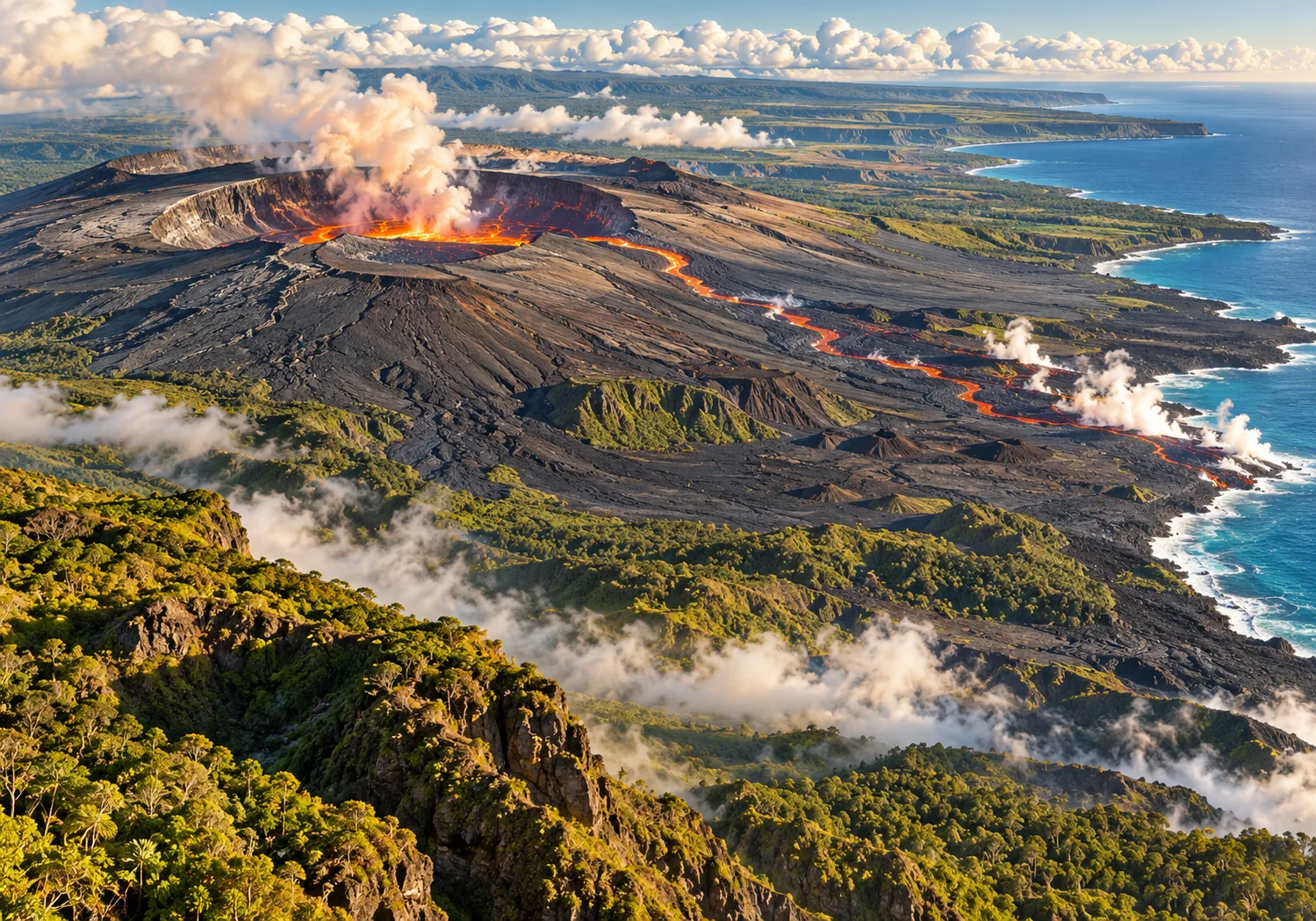
Explore a Hawaiian shield volcano from its surface to its magma pathways. Follow lava as it flows and cools, inspect crystals and volcanic glass, and meet the scientists and wildlife of the surrounding landscape. The illustrations simplify geology and combine different places and times; they do not show current eruption conditions.
Read the illustrated guide
The volcanic island
Hawaiian shield volcanoes grow as many lava flows spread and cool. Their slopes are broad rather than steep cones. This illustrated landscape brings together a summit, rift, coast and nearby habitats; it is not a map of a current eruption.
Enter this sceneInside the volcano
Magma is molten rock beneath the surface. It can gather in storage regions and move through cracks. The cutaway enlarges these pathways and simplifies their shapes. Most of the surrounding crust is solid rock, not a hollow chamber.
Interpretive geological section
At the summit
A caldera is a large depression at a volcano summit. Smaller vents can open within it. Old lava forms layers around the active area. The shape and activity of real craters change over time.
Where magma gathers
Magma can contain liquid melt, crystals and gas. Storage regions may connect to one another. This close view enlarges the crystals and pathways to explain the mixture, rather than showing a measured underground layout.
Cracks become pathways
A dike is a sheet of magma that cuts across surrounding rock. Magma can travel away from a summit along a rift. Some pathways reach the surface, while others cool underground.
Enter this sceneAt the summit
A caldera is a large depression at a volcano summit. Smaller vents can open within it. Old lava forms layers around the active area. The shape and activity of real craters change over time.
Enter this sceneWhere magma gathers
Magma can contain liquid melt, crystals and gas. Storage regions may connect to one another. This close view enlarges the crystals and pathways to explain the mixture, rather than showing a measured underground layout.
Interpretive geological section
Enter this sceneCracks become pathways
A dike is a sheet of magma that cuts across surrounding rock. Magma can travel away from a summit along a rift. Some pathways reach the surface, while others cool underground.
Interpretive geological section
Enter this sceneGas inside magma
Gas can form bubbles in rising magma. As pressure falls, bubbles can grow. Gas helps drive some eruptions. The bubbles and crystals here are an enlarged teaching view, not a place a person could enter.
Enlarged teaching view
Enter this sceneA fissure opens
When magma erupts, it is called lava. A fissure eruption can send lava from several points along a crack. The fountains fall back and feed flows across the ground. This scene is illustrative, not a live eruption report.
Enter this sceneThe flowing channel
Lava can move in a channel bordered by cooling rock. Dark pieces of crust may float on the molten surface. The flow loses heat as it travels. Its speed and appearance depend on the lava and terrain.
Ropes of cooling lava
Pahoehoe lava can form smooth, ropy surfaces. A cooling skin bends as hot lava moves beneath it. These folds preserve part of the flow story after the rock becomes solid.
Inside a lava tube
A lava tube can form when the surface of a flow hardens while lava continues beneath it. The roof helps the stream retain heat. This cutaway removes part of the roof so the flow can be seen.
Enter this sceneRopes of cooling lava
Pahoehoe lava can form smooth, ropy surfaces. A cooling skin bends as hot lava moves beneath it. These folds preserve part of the flow story after the rock becomes solid.
Enter this sceneA rougher surface
Aa lava has a rough surface of broken clinker. Moving lava breaks and pushes pieces along. Pahoehoe and aa are surface forms of basaltic lava, rather than two completely different kinds of rock.
Enter this sceneInside a lava tube
A lava tube can form when the surface of a flow hardens while lava continues beneath it. The roof helps the stream retain heat. This cutaway removes part of the roof so the flow can be seen.
Interpretive geological section
Enter this sceneAfter the lava drains
A tube may remain after lava drains away and the rock cools. Marks along its walls can show former flow levels. This scene shows a cooled passage, not a tunnel beside active lava.
Enter this sceneCrystals in basalt
Basalt forms when basaltic lava cools. Some basalt contains visible olivine crystals. These green grains grew as magma cooled. Their size and amount vary between rocks.
A closer look at olivine
Olivine is a mineral that can form in basaltic magma. Scientists study its composition to learn about magma history. This enlarged view reveals small grains, not giant gemstones hidden in a cave.
Enter this sceneA closer look at olivine
Olivine is a mineral that can form in basaltic magma. Scientists study its composition to learn about magma history. This enlarged view reveals small grains, not giant gemstones hidden in a cave.
Enlarged teaching view
Enter this sceneGlassy threads and drops
Peles hair and Peles tears are forms of volcanic glass. Thin strands and drops can form as lava is stretched or thrown through the air. The fine fibers are sharp; this is a specimen view, not an invitation to touch or collect them.
Enter this sceneBubbles frozen in rock
Scoria is volcanic rock with many holes called vesicles. They formed from gas bubbles before the rock hardened. Dark basaltic cinders can show these spaces clearly. This specimen is not white pumice.
Enter this sceneWatching from a distance
Volcanologists study activity using observations and instruments. Binoculars help reveal details from a distant station. Field access depends on local conditions and official guidance; this scene is not a route or safety assessment.
Listening to the ground
A seismometer records ground motion. Networks of instruments help scientists locate earthquakes and study changes beneath a volcano. The sensor needs a stable connection to the ground. Other instruments provide different clues.
Enter this sceneListening to the ground
A seismometer records ground motion. Networks of instruments help scientists locate earthquakes and study changes beneath a volcano. The sensor needs a stable connection to the ground. Other instruments provide different clues.
Enter this sceneMeasuring slow movement
A fixed GNSS station uses satellite signals to measure its position. Repeated measurements can reveal slow ground movement. Scientists compare many observations; one station does not give the whole story.
Enter this sceneReading a rock
A petrographic microscope helps scientists examine a thin slice of rock. Minerals and textures give clues about how it formed. Laboratory work connects tiny details with observations of the larger volcano.
Enter this sceneA forest surrounded by lava
A kipuka is an older area surrounded by younger lava. Forest can remain there when a flow passes around it. It is not a forest that grew instantly on hot lava. Plants and animals use these surviving habitats.
A bird in the blossoms
Apapane are native Hawaiian birds. They visit flowers in native forests and feed on nectar and small invertebrates. Ohia trees provide food and shelter. This forest habitat is separate from the active flow.
Enter this sceneNene on old lava
Nene are Hawaiian geese. Their strong feet and reduced webbing help them walk across rough ground. They use several habitats, including shrubland and old lava landscapes. These birds are on fully cooled rock.
Enter this sceneA bird in the blossoms
Apapane are native Hawaiian birds. They visit flowers in native forests and feed on nectar and small invertebrates. Ohia trees provide food and shelter. This forest habitat is separate from the active flow.
Enter this sceneSmall life on cooled lava
Some Hawaiian crickets live on young lava landscapes after the surface has cooled. Windblown material brings food into this sparse habitat. This insect is enlarged for a closer view; it is not standing on molten lava.
Enlarged teaching view
Enter this sceneA landscape that keeps changing
Field notes, rock samples and instruments help scientists build an understanding of volcanoes. Their work continues between eruptions. Return to the overview to follow another pathway, inspect a rock or visit the surrounding habitats.
Enter this scene