
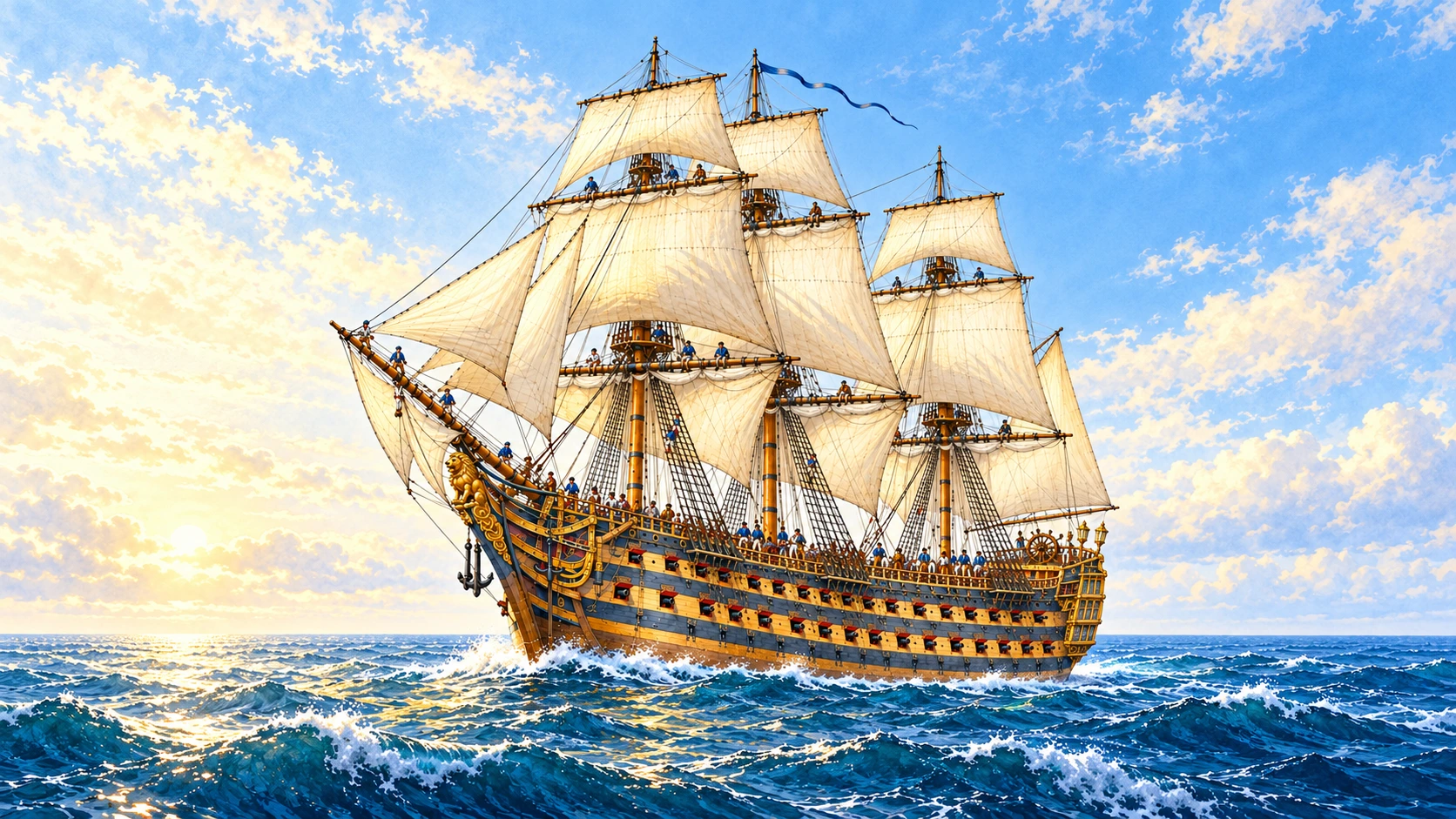
Ship of the Line
An interpretive view of a generic British three-decker around 1790. The room arrangements and close-ups explain life aboard; they are not surveyed plans of a named vessel.
Enter this sceneOpen the hull and walk the decks of a great sailing ship.
A ship of the line was one of the biggest wooden sailing ships ever built. Open the hull, then walk from deck to deck to see how hundreds of sailors lived and worked at sea, around 1790.
An interpretive view of a generic British three-decker around 1790. The room arrangements and close-ups explain life aboard; they are not surveyed plans of a named vessel.
Enter this sceneWhat was inside a big wooden sailing ship? Open the hull of a ship of the line and walk into the quarterdeck, galley, gun decks, hold and more. This picture opens the ship from bow to stern. Tap a door to step onto a deck or into a room, and find out how hundreds of sailors lived on board.
Go outside to see the parts of the ship: the masts, the sails, the anchor, the figurehead and more.
A big ship of the line could carry more than 30 sails at once.
The quarterdeck is the raised deck at the back. The captain and officers commanded the ship from here.
The ship's wheel was on the quarterdeck, so the captain could watch the helmsman steer.
The captain's cabin is at the very back of the ship, with a row of big windows looking out to sea.
The captain was the only person on board with a large room of his own.
Meet the crew: see how sailors worked, ate, slept, washed their clothes and spent their free time.
A big ship of the line had a crew of hundreds of men and boys, like a small floating town.
Sailors slept in hammocks hung side by side from the beams, close to the cannons on the gun decks.
Hammocks were rolled up every morning and stored along the sides of the upper deck.
The galley is the ship's kitchen. The cook made meals for the whole crew on a big iron stove.
The galley stove was the only place on the ship where a fire was allowed to burn every day.
A ship of the line has three decks lined with cannons, one above the other, called the gun decks.
The biggest cannons sat on the lowest gun deck, because their weight helped keep the ship steady.
See the ship cut across the middle, from the top deck down to the keel, with every deck stacked in between.
Below the waterline, the decks were dark, because no windows could be cut there.
The hold is the big storeroom at the bottom of the ship, full of barrels, sacks and heavy ballast stones.
A ship of the line carried enough food and water for months at sea.
The powder magazine is a locked room deep inside the ship, built to keep gunpowder safe and dry.
It was below the waterline, where it was safest from fire.
Learn the parts of a ship for kids: sails, masts, tops, figurehead, bowsprit, anchor, hull, gun ports and stern. Furl the sails and raise the anchor. A tall sailing ship from about 1790, from the pennant at the top of the mast to the hull in the water. Tap each part to learn its name and what it did.
The sails are big sheets of strong canvas. When the wind fills them, they push the whole ship through the water.
Sailors furled, or rolled up, the sails onto the wooden yards when the wind was too strong.
The three tall masts hold up the sails. Hundreds of ropes, called the rigging, keep the masts standing and move the sails.
The masts are named fore, main and mizzen, from the front of the ship to the back.
Halfway up each mast is a wooden platform called a top. Sailors climbed up there to work the sails and keep watch.
The barrel-shaped crow's nest came later, in the 1800s. On this ship, lookouts stood on the tops.
The figurehead is the carved figure at the front of the ship. This one is a golden lion.
Lions were a popular figurehead on British warships of the 1700s.
The bowsprit is the long pole that sticks out from the front of the ship. Ropes and small sails are tied to it.
The front of a ship is called the bow, and the back is called the stern.
The anchor is a huge iron hook on a thick rope cable. Dropped to the sea floor, it stops the ship from drifting away.
The anchor cable was made of hemp rope, as thick as a grown-up's leg.
The hull is the body of the ship. It was built from thousands of oak planks fixed onto strong wooden ribs.
Building one big ship of the line could use the wood of thousands of oak trees.
The rows of square doors along the side are gun ports. Each one opens so a cannon can poke out.
The yellow and black stripes painted along the gun ports were a common style on British ships of the time.
The ship carried smaller boats on deck. Sailors used them to row to shore or to carry things to other ships.
The boats were lifted over the side with ropes and pulleys, like a crane.
The stern is the back of the ship. Its rows of windows let light into the captain's and officers' cabins.
The rudder, which steers the ship, hangs under the stern.
The long, thin flag at the top of the mainmast is a pennant. It showed the ship was in service with the navy.
Some navy pennants were longer than the ship was wide.
See the ship from above to learn the names of its sides: bow, stern, port and starboard.
Sailors use these names because left and right change when you turn around, but port and starboard never do.
What are the decks of a ship called? See a ship of the line cut across: upper deck, three gun decks, orlop deck, hold, ballast and keel. This picture cuts the ship across the middle. Tap each deck from top to bottom, and turn the crank of the chain pump that keeps the ship dry.
The upper deck is the open deck at the top. Sailors worked the ropes and sails here, out in the wind and weather.
A deck is like a floor of a building, and a big ship of the line had about seven of them.
Just below the top is the upper gun deck, with the lightest cannons. Fresh air and light came in through its gun ports.
When the gun ports were closed, the gun decks were dim and lit by lanterns.
The middle gun deck has another row of cannons. Sailors also ate and slept on the gun decks, between the guns.
Tables for meals hung from the beams and were taken down when there was work to do.
The lower gun deck holds the heaviest cannons, close to the waterline. Its gun ports were only opened in calm water.
Three gun decks is what makes this ship a three-decker.
The orlop is the lowest deck, below the waterline. It held ropes, sails, stores and the surgeon's room.
The name orlop comes from an old Dutch word meaning a deck that runs over the top.
Ballast is heavy stone and iron at the very bottom of the ship. Its weight keeps the ship upright so it does not tip over.
Without ballast, the tall masts and heavy cannons would make the ship roll over in the wind.
The keel is the backbone of the ship, a long, strong beam along the bottom. Every other part is built up from it.
The keel was the first part laid down when building a ship.
The waterline is where the sea meets the side of the ship. Everything below it is underwater.
A heavily loaded ship sits lower in the water, so its waterline rises.
Some sea water always leaked in. Sailors turned the cranks of a chain pump to lift the water out of the bottom of the ship.
The pump has a loop of chain with round discs. Turning the crank pulls the discs up a pipe, and they carry water with them.
Find the names of the sides of the ship, seen from above: bow, stern, port and starboard.
Port and starboard are always the same sides of the ship, whichever way you are facing.
Port vs starboard, bow and stern: learn the four sides of a ship for kids, on a ship seen from above, and find out where the names come from. Sailors never say left and right on a ship. Seen from above, the ship shows its four sides: bow, stern, port and starboard. Tap each one.
The bow is the front of the ship, the end that points forward. Here it is on the left, with the bowsprit sticking out.
Going toward the bow is called going forward, or fore.
The stern is the back of the ship. Here it is on the right, where the captain's cabin is.
Going toward the stern is called going aft.
Starboard is the right side of the ship when you stand on board and face the bow. In this picture it is at the top.
The word comes from steering board: long ago, ships were steered with an oar on the right side.
Port is the left side of the ship when you stand on board and face the bow. In this picture it is at the bottom.
Port used to be called larboard, but it sounded too much like starboard, so sailors changed it.
This is the top deck, seen from above, with the ship's boats, the hatches and the wheel near the stern.
The square holes in the deck are hatches. Ladders go down through them to the decks below.
On the gun deck, the cannons point out to port and to starboard, in two long rows.
The masts go straight down through every deck to the bottom of the ship.
Lower down are cabins, storerooms and hammocks, all packed tightly into the space inside the hull.
Every corner of the ship was used, because there was so little room for so many people.
The figurehead is the carved figure at the front of the ship. This one is a golden lion. Lions were a popular figurehead on British warships of the 1700s.
Enter this sceneThe three tall masts hold up the sails. Hundreds of ropes, called the rigging, keep the masts standing and move the sails. The masts are named fore, main and mizzen, from the front of the ship to the back.
Enter this sceneHalfway up each mast is a wooden platform called a top. Sailors climbed up there to work the sails and keep watch. The barrel-shaped crow's nest came later, in the 1800s. On this ship, lookouts stood on the tops.
Enter this sceneNow the sails are rolled up on the yards, and the ship slows down. Sailors furled, or rolled up, the sails onto the wooden yards when the wind was too strong.
Enter this sceneThe anchor is a huge iron hook on a thick rope cable. Dropped to the sea floor, it stops the ship from drifting away. The anchor cable was made of hemp rope, as thick as a grown-up's leg.
Enter this sceneThe crew turned the capstan to haul the anchor up out of the water. The anchor cable was made of hemp rope, as thick as a grown-up's leg.
Enter this sceneThe ship carried smaller boats on deck. Sailors used them to row to shore or to carry things to other ships. The boats were lifted over the side with ropes and pulleys, like a crane.
Enter this sceneNow the boat is in the water, ready for the sailors to row away. The boats were lifted over the side with ropes and pulleys, like a crane.
Enter this sceneWhat is the quarterdeck of a ship? Meet the captain and the navigating officer, turn the ship's wheel and see the compass and lanterns. The quarterdeck is the raised deck at the back of the ship, where the officers commanded. Turn the wheel to see how the ship was steered.
The captain is in charge of the whole ship and everyone on board. He watches the sea and the sails from the quarterdeck.
Only the captain and officers were usually allowed to walk on the quarterdeck.
The navigating officer, called the master, works out where the ship is and which way to sail, using charts and instruments.
He used a sextant to measure the height of the sun at noon and work out how far north or south the ship was.
The ship's wheel steers the ship. Ropes run from the wheel down to a long pole called the tiller, which turns the rudder.
In stormy weather, it could take several sailors to hold the wheel steady.
The binnacle is the wooden stand in front of the wheel that holds the compass, so the helmsman can see it while steering.
A small lamp inside the binnacle lit the compass at night.
Big lanterns at the back of the ship were lit at night so other ships could see where it was.
The lanterns burned candles or oil behind glass, to keep the flame safe from the wind.
The rope ladders that go up the sides of the masts are called ratlines. Sailors climbed them to reach the sails.
Ratlines are tied across the thick ropes that hold up the masts, called shrouds.
Under the quarterdeck, at the very back of the ship, is the captain's cabin.
The captain's steward looked after his cabin, his clothes and his meals.
The captain is in charge of the whole ship and everyone on board. He watches the sea and the sails from the quarterdeck. Only the captain and officers were usually allowed to walk on the quarterdeck.
Enter this sceneThe navigating officer, called the master, works out where the ship is and which way to sail, using charts and instruments. He used a sextant to measure the height of the sun at noon and work out how far north or south the ship was.
Enter this sceneOn the chart table are a compass, dividers for measuring distances, a telescope and a sextant. Without satellites or maps on screens, sailors found their way using the sun, the stars and careful sums.
Enter this sceneThe ship's wheel steers the ship. Ropes run from the wheel down to a long pole called the tiller, which turns the rudder. In stormy weather, it could take several sailors to hold the wheel steady.
Enter this sceneTurning the wheel pulls the ropes, which swing the tiller and turn the rudder under the stern. In stormy weather, it could take several sailors to hold the wheel steady.
Enter this sceneStep into the captain's cabin of a ship of the line: the stern windows, the berth, the table, the sextant and the sea chest, explained for kids. At the very back of the ship, the captain had the biggest room on board. Look closer at where he worked, ate and slept.
The captain plans the voyage at his table, writing letters, reading orders and checking the charts.
The captain kept a logbook, a daily record of the weather, the ship's position and everything that happened.
The big windows at the back of the ship fill the cabin with light and look out over the sea behind the ship.
Behind the windows runs a small outside balcony called the stern gallery.
The captain's bed is a small box bed, called a berth or cot, with curtains to keep out the light.
Some captains slept in a cot that hung from the ceiling and swung with the waves.
The captain's table was used for work, for maps and for meals, when he invited his officers to dine with him.
Being invited to dine with the captain was an honor for a young officer.
The brass instrument on the table is a sextant. It measures the angle between the horizon and the sun or a star.
The sextant was invented in the 1750s, not long before this ship sailed.
The captain kept his clothes, papers and belongings in a strong wooden sea chest that would not slide around.
Sea chests were often wider at the bottom, so they would not tip over when the ship rolled.
Up on the quarterdeck, above the cabin, the officers steer and command the ship.
The captain could reach the quarterdeck in seconds when he was called.
The officers ate together in a cabin at the back of the ship, with plates, glasses and a tablecloth. Officers often brought their own extra food on board, such as live chickens and fresh fruit.
Enter this sceneExplore the gun deck of a ship of the line for kids: cannons, carriages, gun ports, ropes and the sailors who looked after them. A three-decker had three gun decks, one above the other. Sailors worked, ate and slept here, right next to the cannons.
Each cannon is a heavy iron tube. The biggest ones on the ship weighed more than two cars.
A ship of the line carried about 100 cannons on its three gun decks.
The cannon sits on a wooden carriage with four small wheels, called trucks, so the crew could move it in and out.
The carriages were often painted red.
The square opening in the side of the ship is a gun port. Its heavy lid could be closed to keep the sea out.
On the lowest deck, the gun ports were only a little above the waves.
Ropes and pulleys, called tackle, hold each cannon in place and help the crew pull it back and forth.
A loose cannon rolling on a moving deck was very dangerous, so every gun was tied down when not in use.
Ropes are coiled neatly on the deck so that nobody trips over them and they are ready to use.
Sailors kept their decks very tidy and scrubbed them clean almost every morning.
Each cannon needed a team of sailors to look after it. They also lived, ate and slept on this deck.
Each gun crew practised often, so that every sailor knew his job.
The deck was washed with water and scrubbed with mops and blocks of sandstone called holystones.
Holystones were called that because sailors knelt down to use them.
Down below, deep in the ship, is the powder magazine, where gunpowder was stored safely.
Gunpowder was carried up to the gun decks in closed wooden or leather cases.
Nearby, the ship's carpenter has a workbench full of tools for repairing the ship.
The carpenter was one of the most important people on board, because the whole ship was made of wood.
How did old ships keep gunpowder safe? Explore the powder magazine: the barrels, the light room, the heavy door and the safety rules. Deep inside the ship, the powder magazine was built to keep gunpowder dry and far from any flame. Look closer at how it stayed safe.
Gunpowder was kept in small wooden barrels stacked on racks, so it stayed dry and could not roll.
The barrels were held together with wooden or copper hoops, not iron, to avoid sparks.
The magazine has no lamp inside. Light shines in through a thick glass window from a separate small room next door.
This way, no flame ever came near the gunpowder.
A thick wooden door with iron fittings keeps the magazine closed and locked.
The magazine was built below the waterline, the safest place in the ship.
Only a few sailors worked here. They wore soft shoes and carried no metal tools that could make a spark.
The gunner was the officer in charge of the cannons and the gunpowder.
Gunpowder left the magazine inside closed wooden or leather cases, so it was never carried in the open.
Wet blankets could be hung at the doorway as an extra guard against sparks.
The floor is a raised wooden grating that lets air move underneath and keeps the barrels off any damp.
Damp gunpowder does not work, so keeping it dry was very important.
Up the ladders, the gun decks are where the cannons are kept.
The magazine was far from the gun decks and their open gun ports.
Meet the ship's carpenter on a ship of the line: the tools, the workbench, pulley blocks, spare timber and how a wooden hull was built. A wooden ship always needed repairs. Meet the carpenter, then follow him to see how a hull is built.
The carpenter and his crew mend anything made of wood, from broken planks to masts and boats.
The carpenter checked the ship for leaks and measured the water in the bottom every day.
Saws, chisels, drills, hammers and mallets hang on the wall, each in its own place so nothing slides around.
Many of these tools look almost the same as the ones carpenters use today.
The carpenter is smoothing a piece of wood with a plane. Curly wood shavings pile up around the bench.
Spare wood was carried on board so the crew could make new parts at sea.
The round wooden blocks are pulleys. Ropes run through them to lift heavy things and move the sails.
A big ship of the line used more than 1,000 pulley blocks.
Stacks of spare timber are ready to repair the deck, the hull or a broken mast.
Most of the wood came from oak trees, because oak is very strong and lasts a long time.
The carpenter's mate is checking a pulley block to see if it needs repair.
Young sailors learned the carpenter's trade by working as helpers on board.
The workshop sits close to the gun deck, so the carpenter can reach any part of the ship quickly.
The carpenter's crew carried plugs to stop leaks quickly if the hull was damaged.
The carpenter and his crew mend anything made of wood, from broken planks to masts and boats. The carpenter checked the ship for leaks and measured the water in the bottom every day.
Enter this sceneThe hull is the body of the ship. It was built from thousands of oak planks fixed onto strong wooden ribs. Building one big ship of the line could use the wood of thousands of oak trees.
Enter this sceneWhat was in the hold of a sailing ship? Barrels of water and food, sacks, spare equipment, ballast stones and a chain pump, explained for kids. The hold is the storeroom at the bottom of the ship. Find the supplies for a long voyage, then turn the crank of the chain pump.
Rows of barrels hold drinking water, salted meat, peas and other food for the voyage.
The biggest barrels were stored lowest down, where their weight helped keep the ship steady.
Sacks of biscuit, flour and dried peas are piled high, ready to be carried up to the galley.
Food was stored so that the oldest food would be eaten first.
Rounded stones and iron blocks lie at the very bottom. They are the ballast that keeps the ship upright.
The barrels were packed down on top of the ballast so nothing could roll around.
The hold also keeps spare ropes, sails, wood and tools, because there are no shops in the middle of the ocean.
A long voyage could last many months without stopping at a port.
Sailors carry barrels and sacks up and down the ladders between the decks.
Heavy loads were lifted through the hatches with ropes and pulleys.
The masts go all the way down through the ship and stand on the keel, at the very bottom.
The spot where a mast stands on the keel is called the mast step.
Water that leaks into the bottom of the ship is lifted out by a chain pump, turned by sailors with long cranks.
The pump's loop of chain has round discs that pull water up a wooden pipe.
Close by, behind a heavy locked door, is the powder magazine, where gunpowder is stored.
Only a few trusted sailors had the key to the magazine.
Some sea water always leaked in. Sailors turned the cranks of a chain pump to lift the water out of the bottom of the ship. The pump has a loop of chain with round discs. Turning the crank pulls the discs up a pipe, and they carry water with them.
Enter this sceneAs the crank turns, the chain moves and the water spills out over the side. The pump has a loop of chain with round discs. Turning the crank pulls the discs up a pipe, and they carry water with them.
Enter this sceneVisit the galley, the kitchen of a sailing ship: the iron stove, copper pots, the cook, ship's biscuit and fresh water, explained for kids. The galley cooked for hundreds of sailors every day. Meet the cook, then follow the food from the galley to the sailors' tables.
The big black stove is made of iron. It has ovens for baking and a fire box for heating the pots.
The stove stands on a base of bricks and stone, to keep its heat away from the wooden deck.
Huge copper pots hold soup and stew for hundreds of sailors at a time.
Copper heats up quickly, so it was good for cooking big meals fast.
The ship's cook made sure the crew's meals were ready on time, every day, even in bad weather.
Ships' cooks were often older sailors who could no longer climb the masts.
Fresh bread did not last long at sea, so sailors mostly ate ship's biscuit, a hard, dry bread.
Sailors tapped their biscuit on the table before eating it, to knock out any tiny weevils.
Onions, garlic and vegetables hang in nets from the ceiling to keep them dry and out of the way.
Fresh vegetables only lasted the first weeks of a voyage.
Fresh water for cooking and drinking is kept in barrels with taps.
Water was precious at sea, so each sailor was given only a set amount every day.
Behind the galley, on the same deck, sailors sleep in long rows of canvas hammocks.
The warmth of the galley stove made nearby spots popular on cold nights.
The ship's cook made sure the crew's meals were ready on time, every day, even in bad weather. Ships' cooks were often older sailors who could no longer climb the masts.
Enter this sceneSailors ate ship's biscuit, salted beef and pork, dried peas, oatmeal, cheese and butter. Ship's biscuit, also called hardtack, was baked so hard and dry that it could last for months.
Enter this sceneSailors ate together in small groups called messes, at tables set up between the cannons. Each mess took turns sending one sailor to fetch the food from the galley.
Enter this sceneHow did sailors sleep on old sailing ships? See the hammock deck, the sea chests, the lanterns and how sailors mended clothes and relaxed. Sailors slept in rows of hammocks hanging from the beams. Look closer, then follow two sailors mending their clothes.
Hammocks are beds made of canvas that hang from hooks in the beams. They swing gently as the ship rolls.
A hammock moves with the ship, so a sleeping sailor would not fall out in rough seas.
Sailors kept their spare clothes and belongings in wooden sea chests, which also served as seats.
Many sailors shared a chest, or kept their things in a canvas bag instead.
Sailors sit on their chests to mend their clothes. Every sailor learned to sew.
Sailors made many of their own clothes from cloth they bought on board.
Each sailor had a blanket and a thin mattress that was rolled up inside the hammock during the day.
Rolled-up hammocks were packed along the top deck, where they also helped keep out wind and spray.
Lanterns hang from the beams to light the deck below. Their flames burn safely behind glass or horn.
Fire was the greatest danger on a wooden ship, so lights were carefully watched.
The thick wooden beams overhead hold up the deck above. They are so low that tall sailors had to duck.
On the lower decks, there was often not enough room for a grown-up to stand up straight.
Toward the front of the ship is the galley, where the crew's food is cooked.
The smell of the galley stove drifted across the deck at mealtimes.
What was life on a sailing ship like in the 1700s? Follow sailors through their work, meals of hardtack, hammocks, washing and free time. Hundreds of sailors lived together on board. Tap a moment to follow a story: a sailor's day, a meal from the galley, or washing day.
This sailor is hauling on a rope. Sailors worked in teams called watches, taking turns day and night.
A day at sea was split into watches of about four hours, and a bell was rung every half hour.
Sailors ate together in small groups called messes, at tables set up between the cannons.
Each mess took turns sending one sailor to fetch the food from the galley.
Sailors slept in hammocks hung from the beams, packed close together. Half the crew slept while the other half worked.
Each sailor's hammock had only a small space, about as wide as a school notebook is long.
Sailors washed their clothes in tubs of water and sewed up every tear themselves, with a needle and thread.
Washing was often done with sea water, because fresh water was kept for drinking.
Down below, barrels held drinking water, food and everything the crew needed for a long voyage.
Barrels were made by a craftsman called a cooper, who also sailed with the ship.
See the whole crew at once: sailors in the rigging, cooks, carpenters, officers and boys carrying supplies.
Every person on board had a job, from the captain down to the youngest boy.
See the whole crew at once: sailors in the rigging, cooks, carpenters, officers and boys carrying supplies. Every person on board had a job, from the captain down to the youngest boy.
Enter this sceneThis sailor is hauling on a rope. Sailors worked in teams called watches, taking turns day and night. A day at sea was split into watches of about four hours, and a bell was rung every half hour.
Enter this sceneSailors washed their clothes in tubs of water and sewed up every tear themselves, with a needle and thread. Washing was often done with sea water, because fresh water was kept for drinking.
Enter this sceneIn their free time, sailors played music, sang, told stories, carved small objects and made things from rope. Sailors sang work songs called shanties to pull ropes together in time.
Enter this sceneAt night, part of the crew stayed awake to steer the ship, watch the sails and look out for danger. The compass was lit by a small lantern so the helmsman could read it in the dark.
Enter this scene