
Submarine
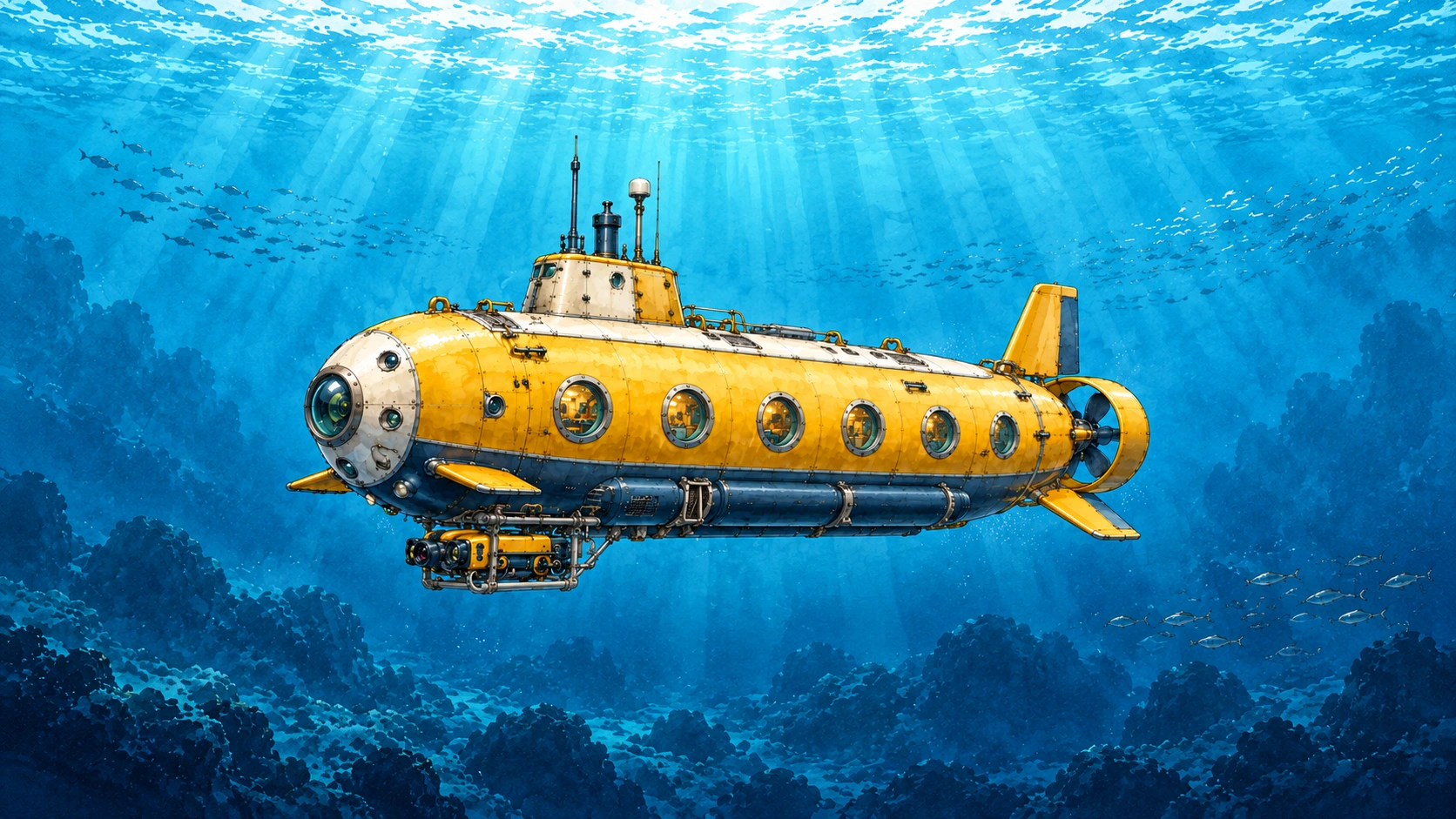
An interpretive civilian battery-electric research submarine. This educational composite is not a named vessel or a verified engineering plan. No operating depth, endurance or crew capacity is specified.
Enter this sceneLook through the hull, then see how a submarine dives.
A research submarine carries a small team of scientists and crew deep under the sea. Look through its hull, then walk from room to room to see how it dives, how the crew lives and what they discover.
An interpretive civilian battery-electric research submarine. This educational composite is not a named vessel or a verified engineering plan. No operating depth, endurance or crew capacity is specified.
Enter this sceneWhat is inside a submarine? Look through the hull with a lens, then walk into the control room, science lab, galley, bunks and engine room. Move the lens over the submarine to look through its hull, then open it up. Tap a door to step into a room, or tap a dot to look closer.
At the front, the pilot drives the submarine from the control room, watching screens and a big round window.
The front window lets the crew see straight out into the sea ahead.
In the lab, scientists study the animals, rocks and water samples they collect from the deep sea.
Many deep-sea animals have never been seen by people before.
The galley is the small kitchen, and the crew eats together around the table next to it.
On a submarine, the table where the crew eats is called the mess.
The crew sleeps in narrow beds stacked one above the other, called bunks, each with a curtain.
Space is so tight on a submarine that every corner has a use.
At the back, an electric motor turns the propeller that pushes the submarine through the water.
Electric motors are very quiet, which helps the crew listen to the sea.
Under the floor are rows of big batteries. They store the electricity for the motor, lights and machines.
The batteries are charged up again when the submarine is back at the surface.
Go outside to see the parts of the submarine: the sail, the hatch, the propeller, the diving planes and more.
The tall tower on top of a submarine is called the sail.
See the submarine cut across the middle to find out how it dives, rises and keeps the crew safe and dry.
The deeper you go in the sea, the harder the water presses on everything.
Follow the crew through a day: work, meals, science, repairs, rest and free time.
The crew works in turns, so someone is always awake to watch over the submarine.
Under the front of the submarine is a small robot with cameras and lights. It can go out on a long cable.
A robot like this is called an ROV, which stands for remotely operated vehicle.
Learn the parts of a submarine for kids: sail, hatch, portholes, diving planes, ballast tanks, propeller, fins and the research robot. A research submarine seen from the outside. Tap each part to learn its name and what it does, and try the diving planes and the ballast tank.
The sail is the tower on top of the submarine. It holds the masts, antennas and lights above the water.
On many submarines, the sail is also where the crew climbs in and out.
The hatch is a round, heavy door on top. The crew climbs down a ladder through it to get inside.
The hatch must be closed and sealed tight before the submarine dives.
Thin masts and antennas stick up from the sail to send radio messages and find the position at the surface.
Radio waves do not travel far through sea water, so radios work best at the surface.
The big round window at the front is very thick and strong, so it can hold back the water outside.
The window is curved like a dome, a shape that is good at resisting pressure.
The round windows along the side are called portholes. The crew can look out at the sea from inside.
Deep down, the sea is dark, so the submarine's lights show what is outside.
The diving planes are small wings on the sides. Tilting them makes the submarine glide up or down as it moves.
Diving planes work a bit like the wings and tail of an airplane.
Ballast tanks are big tanks in the submarine. Filled with air, it floats. Filled with water, it gets heavier and sinks.
To come back up, the crew blows air into the tanks to push the water out.
The propeller at the back spins to push the submarine forward through the water.
The ring around the propeller guides the water and protects the blades.
The fins at the back help keep the submarine steady and steer it left and right.
Fins that steer left and right work like a rudder on a boat.
The yellow robot under the front carries cameras and lights to explore places too small for the submarine.
The robot's cable carries electricity to it and sends its pictures back.
The hull is the body of the submarine. Inside the outer skin is a very strong tube that keeps the crew dry.
The strong inner tube is called the pressure hull.
At the surface, only the top of the submarine shows above the waves, like a whale coming up for air.
When a submarine comes up to the top of the sea, it is called surfacing.
See inside the hull to find out how the submarine dives and keeps the crew safe.
Floating and sinking depend on how heavy something is for its size.
How does a submarine dive and come back up? Fill the ballast tanks, tilt the diving planes and see the pressure hull that keeps the crew dry. This picture cuts the submarine across the middle. Fill a ballast tank with water to make it sink, and tilt the diving planes to steer the dive.
The pressure hull is a thick, round tube of strong metal. It keeps the sea out and the air inside, whatever the depth.
A round shape spreads the push of the water evenly all the way around.
Around the pressure hull is a lighter outer skin, painted yellow and white, that gives the submarine its smooth shape.
Bright colors make a research submarine easy to spot when it comes up.
Ballast tanks sit between the two skins. Letting water in makes the submarine heavier, so it sinks.
Blowing air back into the tanks pushes the water out, and the submarine rises.
Inside the pressure hull, the cabin stays dry and comfortable, at the same air pressure as on land.
The water outside presses harder and harder the deeper you go: about one more air's worth for every 10 meters.
The scientists can work in normal clothes, at a table, while the deep sea is just outside the wall.
They look out through thick windows and watch screens from the cameras outside.
Under the floor are the batteries, pipes and machines that keep the submarine running.
Heavy batteries low down help keep the submarine upright.
Tanks of squeezed air are used to blow the water out of the ballast tanks and make the submarine rise.
Air squeezed into a tank is called compressed air.
Pipes carry air and water, and cables carry electricity to every part of the submarine.
Every pipe and cable is checked before each dive.
Seen from above and from the side, you can find every room in a row, from the front window to the propeller.
The rooms are lined up in a row because the hull is a long tube.
Tilting the small wings at the front makes the moving submarine point its nose up or down.
Ballast tanks change the weight; the diving planes steer the dive.
Go back outside to find every part on the outside of the submarine.
Each part outside has a job in diving, steering or seeing.
Seen from above and from the side, you can find every room in a row, from the front window to the propeller. The rooms are lined up in a row because the hull is a long tube.
Enter this sceneThe hull is the body of the submarine. Inside the outer skin is a very strong tube that keeps the crew dry. The strong inner tube is called the pressure hull.
Enter this sceneThe hatch is a round, heavy door on top. The crew climbs down a ladder through it to get inside. The hatch must be closed and sealed tight before the submarine dives.
Enter this sceneThe sail is the tower on top of the submarine. It holds the masts, antennas and lights above the water. On many submarines, the sail is also where the crew climbs in and out.
Enter this sceneTilting the small wings at the front makes the moving submarine point its nose up or down. Ballast tanks change the weight; the diving planes steer the dive.
Enter this sceneWith the planes tilted, the submarine noses down into the deep. Ballast tanks change the weight; the diving planes steer the dive.
Enter this sceneBallast tanks sit between the two skins. Letting water in makes the submarine heavier, so it sinks. Blowing air back into the tanks pushes the water out, and the submarine rises.
Enter this sceneThe tank is full of sea water: the submarine is heavier and sinks. Blowing air back into the tanks pushes the water out, and the submarine rises.
Enter this sceneAt the surface, only the top of the submarine shows above the waves, like a whale coming up for air. When a submarine comes up to the top of the sea, it is called surfacing.
Enter this sceneExplore a submarine control room for kids: the big front window, the screens, gauges, joystick and diving planes the pilot uses. The pilot drives the submarine from the control room. Look closer at the window, the screens and the joystick.
The big round window at the front is like the submarine's eye, looking straight out into the sea.
Outside lights shine through the dark water so the crew can see ahead.
The pilot sits in a comfortable chair and drives the submarine with a joystick and buttons.
The pilot keeps checking the depth, the direction and the speed.
Screens show pictures from the outside cameras, the map of the sea floor and how all the machines are working.
Cameras outside the hull let the crew see in every direction.
Round dials called gauges show the depth, the air inside, the batteries and the water pressure outside.
A depth gauge works by measuring how hard the water presses.
The pilot uses a joystick, like a game controller, to steer the submarine up, down, left and right.
Small push motors called thrusters help the submarine move slowly and precisely.
From the control room, the pilot tilts the diving planes outside to point the submarine up or down.
Small changes are enough: the submarine moves slowly and smoothly.
Strong lights under the front of the submarine light up the dark water and the sea floor.
Below about 200 meters, almost no sunlight reaches the water.
Next to the pilot, the sonar station listens to the sea and maps the sea floor.
Sonar works even in total darkness, because it uses sound instead of light.
The pilot drives the submarine with a joystick, watching the screens, the gauges and the window. Pilots train for a long time before they take a submarine down.
Enter this sceneHow does submarine sonar work? See the sonar screen and the sea floor map, and find out how echoes help a submarine see in the dark. Deep in the sea it is dark, so the submarine uses sound to see. Look closer at the sonar station.
The round screen shows the echoes coming back: hills, rocks and slopes on the sea floor appear as shapes.
Dolphins and bats use echoes in the same way to find their way.
This screen shows a map of the sea floor in colors, made from thousands of sonar echoes.
Much of the deep sea floor has still not been mapped in detail.
The sonar operator wears headphones to listen to the sounds of the sea.
Whales, dolphins and even shrimp make sounds that can be heard underwater.
Through the porthole, the operator can glimpse rocks and corals lit by the submarine's lights.
Many deep-sea corals grow very slowly, over hundreds of years.
Paper charts lie on the desk, showing the depth of the sea in curving lines.
Lines that join places of the same depth are called contour lines.
The sonar operator watches the screens closely and tells the pilot what lies ahead.
At night, the sonar station is still watched by the night crew.
The sonar station is right next to the pilot in the control room.
The pilot and the sonar operator talk all the time during a dive.
Visit the science lab of a research submarine: samples, jars, a microscope and the robot that collects things from the sea floor. Scientists study what the submarine finds in the deep. Meet a marine scientist and send out the robot.
A marine scientist looks through a microscope at tiny living things from the deep sea.
Some of the tiniest sea creatures can only be seen with a microscope.
This scientist holds a jar with a piece of coral collected from the sea floor.
Samples are labeled carefully with where and when they were found.
Clear jars hold samples of sea water, sand, shells and corals, ready to be studied.
Some samples are kept cold so they stay fresh for study on land.
A microscope makes tiny things look much bigger, so the scientist can see every detail.
Some microscopes can make things look a thousand times bigger.
The screen shows live pictures of the corals outside, filmed by the submarine's cameras.
Pictures and videos from dives help scientists all over the world.
Through the lab's round porthole, fish and corals can be seen just outside the submarine.
Some deep-sea fish make their own light, called bioluminescence.
Next to the lab is the galley, where the crew cooks and eats.
Food and science are kept apart, so samples stay clean.
A marine scientist looks closely at a sample collected from the sea floor. Scientists study deep-sea animals to learn how life survives in the cold and the dark.
Enter this sceneUnder the front of the submarine is a small robot with cameras and lights. It can go out on a long cable. A robot like this is called an ROV, which stands for remotely operated vehicle.
Enter this sceneThe robot drops down on its cable to film the sea floor up close. A robot like this is called an ROV, which stands for remotely operated vehicle.
Enter this sceneHow does a submarine move? See the electric motor, the shaft, the propeller and the tail fins at the back of a research submarine. At the back of the submarine, an electric motor turns the propeller. Look closer at how it moves.
The big blue electric motor uses power from the batteries to turn the propeller.
Electric motors make very little noise compared with engines that burn fuel.
A strong metal rod called the shaft joins the motor inside to the propeller outside.
Special seals stop sea water from leaking in where the shaft goes through the hull.
The propeller's curved blades push water backward, which pushes the submarine forward.
The ring around the propeller is called a duct; it helps push the water straight back.
The tall fin on top of the tail keeps the submarine going straight and helps it turn.
Fish have fins for the same reason: to stay steady and steer.
The fin below the tail balances the one on top and steadies the submarine.
Fins at the back work best when the submarine is moving.
Around the motor are pipes, pumps and boxes that cool the motor and control its power.
Machines in a submarine are packed tightly to save space.
Just in front of the motor room are the crew's bunks and a tiny washroom.
The quiet motor means the crew can sleep close to it.
Where does a submarine get its power? Lift the floor to see the batteries, the orange cables and the engineer who looks after them. Under the floor are the batteries that power the submarine. Meet the engineer who looks after them.
Rows of big blue boxes are the batteries. Together they power everything on the submarine.
The batteries are heavy, and being low in the hull helps keep the submarine steady.
An engineer lifts a floor panel to check the batteries and their cables.
The batteries are checked often to make sure they stay cool and safe.
Thick orange cables carry electricity from the batteries to the motor and the rest of the submarine.
Cables carrying lots of electricity are often colored bright orange as a warning.
A metal walkway runs between the batteries so the crew can reach every one.
The holes in the walkway let air move around the batteries.
The floor of the cabin above lifts up like a lid to reach the batteries underneath.
Most of the submarine's machines are hidden under the floor.
Fans and pipes keep the batteries cool, because they warm up when they work hard.
Batteries last longer when they are kept at a steady temperature.
At the back of the submarine, the batteries' power turns the electric motor.
The motor uses the same kind of power as an electric car.
An engineer checks the electrical systems to make sure everything works safely. Engineers measure electricity with a meter to find any problem early.
Enter this sceneAt the workbench, the crew takes machines apart, cleans them and puts them back together. The crew carries spare parts, because there is no shop under the sea.
Enter this sceneSee the quiet workspace on a research submarine, and open the air module that keeps the air clean and safe to breathe. A quiet corner to write and rest. Open the air module to see how the crew always has clean air.
A crew member writes up the day's notes at a small desk that folds out from the wall.
Notes from every dive are kept so the next team can learn from them.
A big porthole shows the blue sea outside, with fish swimming past.
The water outside the window is very cold in the deep sea.
A screen on the wall shows pictures from the cameras outside the submarine.
The crew can watch the sea even from rooms without windows.
Headphones let the crew listen to music or recordings without disturbing anyone.
In a small space, keeping quiet is a way of being kind to others.
A tall locker holds jackets and warm clothes, because it can get cool inside.
Sea water in the deep is only a few degrees above freezing.
Behind this panel is a machine that cleans the air, taking out the carbon dioxide people breathe out.
The crew also adds fresh oxygen, so the air stays good to breathe for the whole dive.
Further along the corridor is the storeroom with fresh water, food and all the supplies.
Everything the crew needs must fit inside the submarine before it dives.
Behind this panel is a machine that cleans the air, taking out the carbon dioxide people breathe out. The crew also adds fresh oxygen, so the air stays good to breathe for the whole dive.
Enter this sceneInside is the filter that soaks up carbon dioxide from the air. The crew also adds fresh oxygen, so the air stays good to breathe for the whole dive.
Enter this sceneHow does a submarine carry fresh water and food? See the water tank, the pump and the shelves packed with supplies. Everything the crew needs has to fit inside. Look closer at the water tank and the stores.
The big white tank holds fresh water for drinking, cooking and washing.
Even though the submarine is surrounded by water, sea water is too salty to drink.
A blue electric pump pushes the fresh water through pipes to the galley and washroom.
Pumps are checked often, because the crew depends on them.
A technician checks a valve and a filter to make sure the water stays clean.
A valve is like a tap that opens and closes a pipe.
Rows of jars hold rice, pasta, beans and lentils, which keep for a long time.
Dried food is light and takes little space.
Canvas bags hold spare clothes, bedding and equipment, packed tightly on shelves.
Soft bags fit into odd-shaped spaces better than boxes.
Metal boxes with lids hold tools, spare parts and supplies, strapped in place.
Straps stop heavy boxes from moving when the submarine tilts.
A small round porthole lets a little blue light from the sea into the storeroom.
The color of the sea changes from blue to dark as you go deeper.
Below the storeroom floor are the big batteries that power the whole submarine.
The floor panels lift up so the crew can reach the batteries.
A technician fixes a small pump, one of the many machines that move water and air around the submarine. Every tool has its own place, so nothing rolls around when the submarine tilts.
Enter this sceneHow does a submarine crew cook and eat? See the electric stove, the food that keeps for a long time and the small mess table. The galley is the submarine's tiny kitchen. Meet the cook, then follow a meal to the table.
The cook stirs a big pot of vegetable stew on the small electric stove.
Pots have rails around them on the stove so they do not slide.
The stove is electric. There is no gas or open fire anywhere on the submarine.
Keeping fire away is important in a closed space with no windows to open.
A small electric oven bakes bread and warms meals for the whole crew.
The smell of baking bread spreads through the whole submarine.
Even the galley has a porthole, so the cook can see the sea while cooking.
Few kitchens in the world have a view of the deep sea.
Jars of pasta, rice and spices sit on shelves with rails that stop them falling off.
Every shelf on a submarine has a rail or a strap.
The table where the crew eats is called the mess. It is small, so everyone sits close together.
The same table is used for meals, meetings and games.
A crew member brings bowls of food to the table. Breakfast is a cheerful start to the day.
The crew eats at different times, depending on when their shift starts.
Through the doorway at the back are the narrow bunks where the crew sleeps between shifts.
The sleeping area is close to the galley, so it is never far to go.
The cook makes a big pot of stew on a small electric stove, with no open flames. There is no gas or fire on board, because the air must stay clean and safe.
Enter this sceneFood that keeps a long time comes on board: pasta, rice, cans, bread, vegetables and fruit. Every bit of food is planned before the dive, so nothing runs out.
Enter this sceneThe day starts with breakfast together at the small table: fruit, cereal, toast and hot drinks. Fresh fruit is eaten first, because it does not keep as long as canned food.
Enter this sceneAt dinner, the whole crew squeezes around the table to eat and talk about the day. Sharing meals helps a small team get along in a small space.
Enter this sceneWhere does a submarine crew sleep? See the narrow bunks, curtains, reading lights and lockers in the sleeping area. The crew sleeps in narrow bunks stacked one above the other. Look closer at this tiny bedroom.
A crew member sleeps in the top bunk, wrapped in a warm blue blanket.
Some crew members sleep in the day, because they work at night.
The lower bunk has its own pillow, blanket, light and a small net for belongings.
Each bunk is a tiny private space with a curtain.
Curtains close in front of each bunk to keep out the light and give some privacy.
Lights stay on in some parts of the submarine all the time.
Clothes and belongings are kept in small lockers and drawers along the walls.
Each crew member brings only a little, because there is so little room.
A crew member folds towels and puts them away neatly in a cupboard.
Folding things small saves space in the tiny cupboards.
Each bunk has a small lamp, so the crew can read without waking anyone else.
Reading and listening to music help the crew relax before sleep.
A narrow corridor runs along the submarine, past the bunks to the quiet workspace.
Two people have to turn sideways to pass each other in the corridor.
What is life like on a submarine? Follow the crew through a day: driving, sonar, science, repairs, meals, cleaning and free time. A small crew lives and works together under the sea. Tap a moment to follow a story, from breakfast to the night watch.
The day starts with breakfast together at the small table: fruit, cereal, toast and hot drinks.
Fresh fruit is eaten first, because it does not keep as long as canned food.
A marine scientist looks closely at a sample collected from the sea floor.
Scientists study deep-sea animals to learn how life survives in the cold and the dark.
An engineer checks the electrical systems to make sure everything works safely.
Engineers measure electricity with a meter to find any problem early.
The cook makes a big pot of stew on a small electric stove, with no open flames.
There is no gas or fire on board, because the air must stay clean and safe.
Everyone helps keep the submarine clean and tidy: wiping tables, washing dishes and folding clothes.
In a small space, keeping things tidy makes life easier for everyone.
See the whole crew at once: the pilot, the scientists, the technician, the cook and the engineer.
On a small submarine, many people do more than one job.
See the whole crew at once: the pilot, the scientists, the technician, the cook and the engineer. On a small submarine, many people do more than one job.
Enter this sceneEveryone helps keep the submarine clean and tidy: wiping tables, washing dishes and folding clothes. In a small space, keeping things tidy makes life easier for everyone.
Enter this sceneIn their free time, the crew plays music, draws, plays games and chats together. Board games and music are popular because they need no internet.
Enter this sceneAt night, some of the crew stays awake to drive the submarine and watch the screens while others sleep. Deep in the sea, it is dark all the time, so the crew follows a clock instead of the sun.
Enter this scene