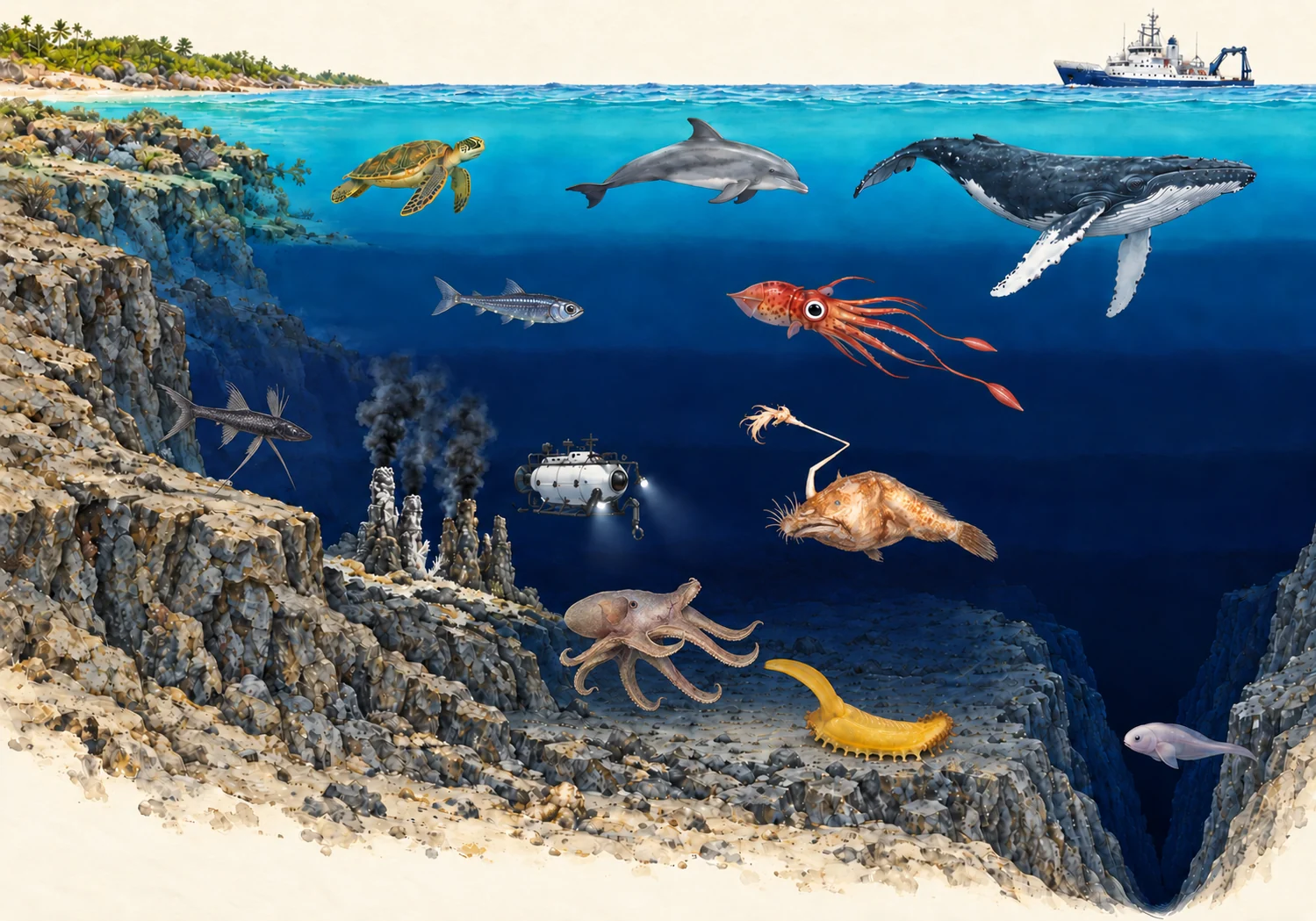
Travel from the sunlit sea to the deepest trenches. This composite picture brings different habitats together; the animals are enlarged so you can find them.
Read the illustrated guide
Ocean Zones
Travel from the sunlit sea to the deepest trenches. This composite picture brings different habitats together; the animals are enlarged so you can find them.
Sunlight zone
Sunlight reaches the upper ocean. Algae and other tiny living things use its energy to grow.
Twilight zone
Only faint sunlight reaches this dim water. Some animals travel upward at night and return deeper during the day.
Midnight zone
Surface sunlight does not reach this part of the ocean. Some animals make their own light.
The abyss
Much of the deep ocean floor is a broad, cold plain. Animals find food in material that drifts down from above.
Ocean trenches
Trenches are deep valleys in the ocean floor. Pressure increases as the water gets deeper.
Continental shelf
The shallow seabed beside a continent forms its continental shelf. Farther out, the ground slopes toward the deep ocean.
Coral reef
Corals build complex habitats in warm, shallow seas. Fish and many other animals find shelter among them.
Hydrothermal vents
Hot mineral-rich water flows from cracks in the seafloor. Microbes use chemical energy here, supporting a local community.
Research submersible
A small research vehicle carries cameras and tools into deep water. Strong walls protect its equipment and passengers.
Green sea turtle
Green sea turtles are reptiles that breathe air. Many feed in shallow coastal habitats and return to the surface to breathe.
Bottlenose dolphin
Dolphins are mammals. They breathe air and use sound to find their way and locate food underwater.
Humpback whale
A humpback whale has long flippers and a powerful tail. Like other whales, it must come to the surface to breathe.
Lanternfish
Small light-producing organs dot the bodies of lanternfish. Many move toward shallower water at night.
Strawberry squid
This deep-water squid has two eyes of different sizes. Its larger eye helps it look upward for faint light.
Deep-sea anglerfish
Some deep-sea anglerfish carry a small glowing lure in front of their mouths. It helps attract prey in dark water.
Dumbo octopus
Finned deep-sea octopuses move through the water using their fins and arms. The fins inspired their familiar nickname.
Tripod fish
Long fin rays help this fish stand above the seabed. It can face the current while waiting for food.
Abyssal sea cucumber
Sea cucumbers move across the deep seafloor. Many gather food particles from the sediment.
Hadal snailfish
Some snailfish live in deep ocean trenches. This illustration places one in the upper trench, not at its deepest bottom.
Enter this sceneSunlight zone
Sunlight reaches the upper ocean. Algae and other tiny living things use its energy to grow.
Enter this sceneTwilight zone
Only faint sunlight reaches this dim water. Some animals travel upward at night and return deeper during the day.
Enter this sceneMidnight zone
Surface sunlight does not reach this part of the ocean. Some animals make their own light.
Enter this sceneThe abyss
Much of the deep ocean floor is a broad, cold plain. Animals find food in material that drifts down from above.
Enter this sceneOcean trenches
Trenches are deep valleys in the ocean floor. Pressure increases as the water gets deeper.
Enter this sceneContinental shelf
The shallow seabed beside a continent forms its continental shelf. Farther out, the ground slopes toward the deep ocean.
Enter this sceneCoral reef
Corals build complex habitats in warm, shallow seas. Fish and many other animals find shelter among them.
Enter this sceneHydrothermal vents
Hot mineral-rich water flows from cracks in the seafloor. Microbes use chemical energy here, supporting a local community.
Enter this sceneResearch submersible
A small research vehicle carries cameras and tools into deep water. Strong walls protect its equipment and passengers.
Enter this sceneGreen sea turtle
Green sea turtles are reptiles that breathe air. Many feed in shallow coastal habitats and return to the surface to breathe.
Enter this sceneBottlenose dolphin
Dolphins are mammals. They breathe air and use sound to find their way and locate food underwater.
Enter this sceneHumpback whale
A humpback whale has long flippers and a powerful tail. Like other whales, it must come to the surface to breathe.
Enter this sceneLanternfish
Small light-producing organs dot the bodies of lanternfish. Many move toward shallower water at night.
Enter this sceneStrawberry squid
This deep-water squid has two eyes of different sizes. Its larger eye helps it look upward for faint light.
Enter this sceneDeep-sea anglerfish
Some deep-sea anglerfish carry a small glowing lure in front of their mouths. It helps attract prey in dark water.
Enter this sceneDumbo octopus
Finned deep-sea octopuses move through the water using their fins and arms. The fins inspired their familiar nickname.
Enter this sceneTripod fish
Long fin rays help this fish stand above the seabed. It can face the current while waiting for food.
Enter this sceneAbyssal sea cucumber
Sea cucumbers move across the deep seafloor. Many gather food particles from the sediment.
Enter this sceneHadal snailfish
Some snailfish live in deep ocean trenches. This illustration places one in the upper trench, not at its deepest bottom.
Enter this sceneLight with depth
Water absorbs sunlight as it travels down. Bright surface water gradually gives way to twilight and then darkness.
Enter this sceneMarine snow
Small pieces of organic material drift through the water. This falling material carries food toward the deep ocean.
Enter this sceneLiving lights
Photophores are organs that produce light. Their patterns can help animals hide or communicate in dim water.
Enter this sceneDaytime migration
Many small ocean animals spend the day in deeper water, where less sunlight makes them harder to see.
Enter this sceneNighttime migration
At night, some animals rise toward the surface to feed. Not every animal makes this journey.
Enter this sceneLife in the upper trench
The upper trench can support animals adapted to its pressure and darkness. Fish are not shown at the deepest trench tip.
Enter this sceneResearch vessel
A surface ship carries researchers, equipment and supplies. Its crew supports the work happening below.
Enter this sceneObservation room
Researchers watch underwater camera images and keep records. Careful observation helps them understand what they see.
Enter this sceneRemote vehicle pilot
A pilot aboard the ship guides an underwater vehicle using cameras and controls. The pilot stays at the surface.
Enter this scenePlankton laboratory
Researchers examine tiny organisms collected from the water. Samples reveal life that is difficult to see from the deck.
Enter this sceneCamera technician
A technician prepares cameras before they enter the water. Good images help the team record animals and habitats.
Enter this sceneA meal aboard
The crew shares ordinary meals aboard the research ship. Work at sea depends on rest, food and teamwork.
Enter this scenePreparing food
The ship’s cook prepares food in the galley. Supplies must last throughout the research voyage.
Enter this sceneCaring for equipment
The crew cleans and checks equipment between dives. Careful maintenance helps keep it ready for the next trip.
Enter this sceneRest between watches
Crew members rest when their watch is over. A ship’s work continues as different teams take turns.
Enter this sceneNight watch
Research can continue after dark. The team watches equipment and records what happens during the night.
Enter this scene