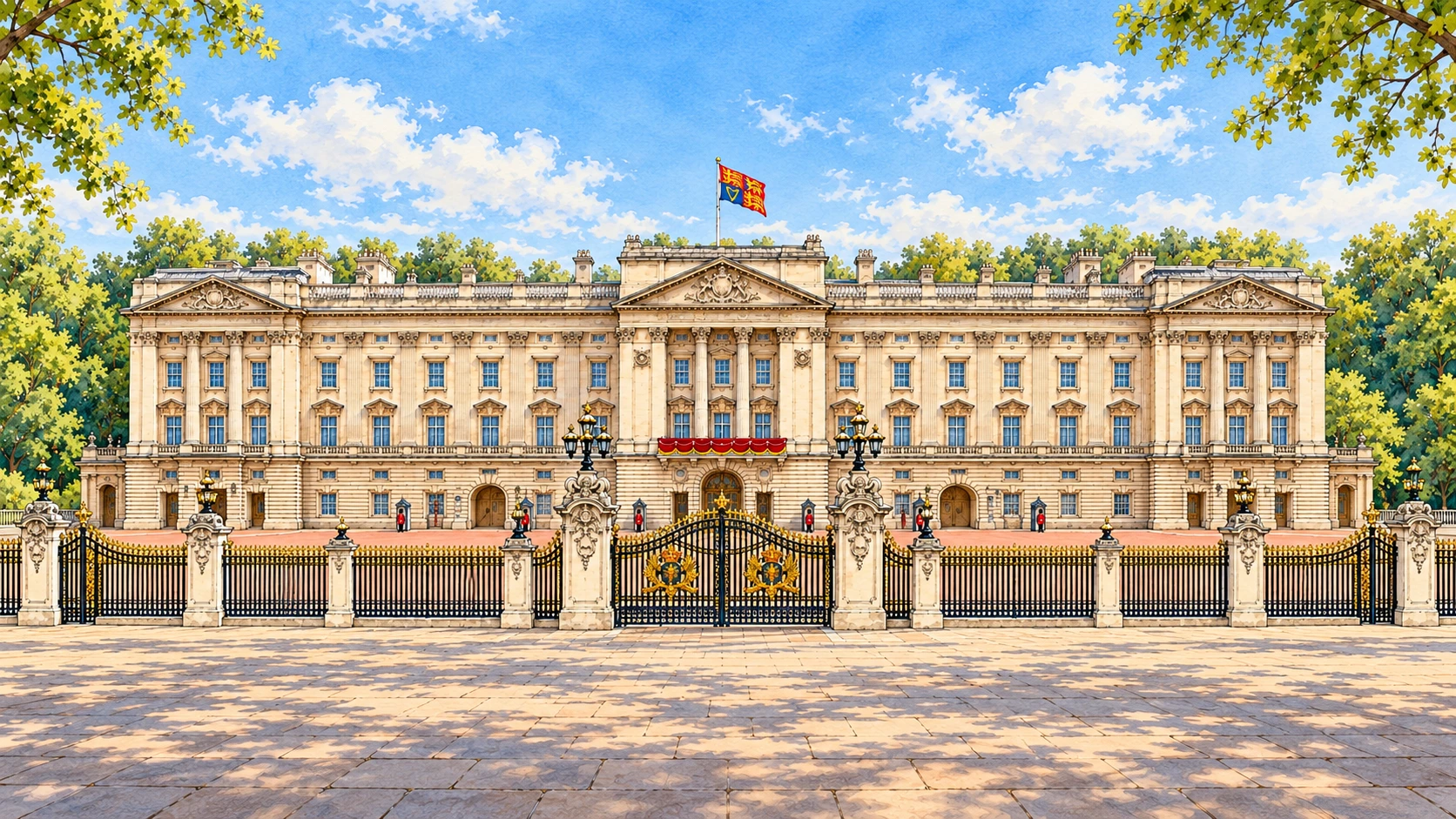
Buckingham Palace in London is the home and office of the British monarch. Open the palace, walk through its grand State Rooms, and go behind the scenes to meet the people who keep it running.
Read the illustrated guide
Buckingham Palace
Explore the State Rooms and an illustrated working household. Service spaces, clothing, food and guests are interpretive, not a record of a named event or current private-room access. Cutaways rearrange rooms for discovery and are not surveyed floor plans.
Enter this sceneInside Buckingham Palace
What is inside Buckingham Palace? Open the palace and walk into the Throne Room, Ballroom, Picture Gallery and the room behind the famous balcony. This picture opens Buckingham Palace like a doll's house. Tap a door to walk into a State Room, or tap a dot to look closer.
Throne Room
The Throne Room is a grand red and gold room used for special ceremonies and royal photographs.
Many royal wedding photographs have been taken in the Throne Room.
Grand Staircase
Visitors to the State Rooms climb this wide, curving staircase, past portraits of kings and queens.
The staircase was designed by the architect John Nash, who rebuilt the palace in the 1820s.
Picture Gallery
The Picture Gallery is a long room with a glass roof, so daylight falls on famous paintings from the Royal Collection.
It is about 47 meters (154 feet) long.
Ballroom
The Ballroom is the biggest room in the palace. It is used for State Banquets, ceremonies and concerts.
It opened in 1856, in the time of Queen Victoria.
White Drawing Room
The White Drawing Room is a white and gold room where the royal family gathers before big events.
It has a secret door hidden behind a mirror and a cabinet.
Centre Room
The Centre Room is right behind the famous balcony. Its walls are decorated in a Chinese style.
The royal family steps out onto the balcony through the doors of this room.
The balcony
The balcony in the middle of the front of the palace is where the royal family waves to the crowds on special days.
Queen Victoria was the first to appear on the balcony, in 1851.
Behind the scenes
Hundreds of people work in the palace: chefs, cleaners, gardeners, florists and experts who look after treasures.
Buckingham Palace has 775 rooms, and only 19 of them are State Rooms.
Forecourt
The big courtyard in front of the palace is called the forecourt. Guards in red tunics and tall black hats stand on duty here.
The Changing of the Guard ceremony takes place in the forecourt.
The gardens
Behind the palace is a huge garden with lawns, flower beds, trees and a lake, looked after by a team of gardeners.
It is the largest private garden in London, about 39 acres.
The household
Getting the palace ready takes teamwork: people clean, cook, polish silver, arrange flowers and set the tables.
The people who work for the royal family are called the Royal Household.
Enter this sceneThe palace forecourt
The big courtyard in front of the palace is called the forecourt. Guards in red tunics and tall black hats stand on duty here. The Changing of the Guard ceremony takes place in the forecourt.
Enter this sceneThe Grand Staircase
Climb the Grand Staircase at Buckingham Palace: two curving flights of stairs, a golden balustrade, royal portraits and footmen in red coats. Visitors climb the Grand Staircase to reach the State Rooms. Look closer at its golden railing and portraits.
Staircase
Two curving flights of red-carpeted stairs sweep up from the hall to the State Rooms above.
Guests arriving for State Banquets climb these stairs.
Golden balustrade
The railing, called a balustrade, is made of gilded bronze shaped into curling leaves and scrolls.
Gilded bronze is a metal covered with a thin coat of gold.
Statue
A statue stands at the top of the stairs, holding up a lamp to light the way.
Statues that hold lamps are called torchbearers.
Royal portraits
Portraits of kings and queens from Queen Victoria's family line the walls above the stairs.
Royal portraits were painted to show how important and grand their sitters were.
Footmen
Footmen in red coats help guests find their way on busy days of ceremonies and banquets.
A footman's red coat is part of the royal livery, a special uniform.
Green Drawing Room
At the top of the stairs, the way leads on into the Green Drawing Room.
The State Rooms are on the first floor, above the ground floor.
Enter this sceneThe Throne Room
Explore the Throne Room at Buckingham Palace for kids: the thrones, the canopy of state, the crystal chandeliers and the carved frieze. The Throne Room is used for special ceremonies and royal photographs. Look closer at the thrones and the room around them.
Thrones
The two thrones are chairs of state, carved, gilded and covered in red velvet. They stand on a low platform.
The platform for the thrones is called a dais.
Canopy
Above the thrones hangs a canopy of red and gold fabric, a sign of royal power since medieval times.
A canopy over a throne is called a canopy of state.
Chandeliers
Sparkling crystal chandeliers hang from the ceiling and fill the room with light during ceremonies.
Palace chandeliers are taken down and cleaned piece by piece by hand.
Frieze
High up on the walls, a carved white band called a frieze shows knights and battles from English history.
The frieze shows scenes from the Wars of the Roses, fought in England in the 1400s.
Attendant
Palace staff dust and check every chair and table so the room is perfect for the next ceremony.
Staff often wear soft gloves to avoid leaving fingerprints on gold surfaces.
Green Drawing Room
Through the doors is the Green Drawing Room, where guests wait before entering the Throne Room.
A room where guests wait before a ceremony is called an anteroom.
Enter this sceneThe Green Drawing Room
Explore the Green Drawing Room at Buckingham Palace: green silk walls, royal portraits and the flowers that staff bring in before events. Guests wait in the Green Drawing Room before entering the Throne Room. Follow the staff who get the rooms ready.
Green silk walls
The walls are covered with green silk, which gives the room its name.
Many State Rooms are named after their colors: green, blue and white.
Portraits
Large paintings of kings and queens from long ago hang in golden frames around the room.
These paintings belong to the Royal Collection, one of the biggest art collections in the world.
Chandelier
A crystal chandelier hangs from the high, decorated ceiling, catching the light from the windows.
The glass ceiling above lets daylight into the room.
Cabinet
Under the paintings stand dark cabinets decorated with patterns of brass and shell set into the wood.
Pictures made from pieces of wood, brass or shell set into furniture are called inlay.
Fresh flowers
Florists bring fresh flower arrangements into the State Rooms before visitors and events.
Many of the flowers come from the palace gardens and royal estates.
Picture Gallery
Through the middle doors, the long Picture Gallery stretches into the distance.
The doors line up so you can see through several rooms at once.
Throne Room
On the other side of the room, doors open into the red and gold Throne Room.
Guests of honor walk through this room on their way to ceremonies.
Enter this sceneThe Picture Gallery
Walk through the Picture Gallery at Buckingham Palace for kids: a glass roof, famous paintings, and the experts who look after them. The Picture Gallery is lit from above by a long glass roof. Meet the conservator who cares for its paintings.
Glass roof
The long glass roof lets soft daylight fall from above, the best light for looking at paintings.
Light from above does not shine back off the paintings like light from a window would.
Paintings
The walls are covered with paintings by famous artists, hung close together in golden frames.
Works by artists such as Rembrandt, Rubens and Vermeer are part of the Royal Collection.
Fireplace
Carved marble fireplaces stand along the walls, with figures and decorations cut into the stone.
Marble is a stone that can be carved into fine details and polished to shine.
Sofas
Long sofas with striped covers let visitors sit and look at the paintings.
The fabrics on old furniture are carefully repaired or copied when they wear out.
Painting conservator
A conservator looks after old paintings, cleaning them gently and repairing tiny cracks with very fine brushes.
Conservators use magnifying glasses and microscopes to see the smallest details.
Green Drawing Room
At the far end of the gallery, doors lead on to the Green Drawing Room and the other State Rooms.
Visitors walk through the State Rooms one after another, in a long loop.
Enter this sceneThe conservator
A conservator looks after old paintings, cleaning them gently and repairing tiny cracks with very fine brushes. Conservators use magnifying glasses and microscopes to see the smallest details.
Enter this sceneConservation workshop
In the workshop, experts repair gilded chairs and frames, using tools and methods from hundreds of years ago. Gilding means covering wood with a very thin layer of real gold, called gold leaf.
Enter this sceneThe upholsterer
An upholsterer repairs the padding and fabric of chairs and sofas, stitching everything by hand. Some palace chairs are more than 200 years old and still used.
Enter this sceneTextile store
Spare fabrics, carpets and curtains are rolled and stored, ready to repair or replace old ones. Some fabrics are specially woven to match the originals exactly.
Enter this sceneThe White Drawing Room
Find the secret door in the White Drawing Room at Buckingham Palace: a mirror and cabinet that swing open, explained for kids. The White Drawing Room hides a secret: one of its mirrors is really a door. Find it and open it.
Secret door
This mirror and cabinet look like part of the wall, but they swing open like a door.
The royal family can use this hidden door to come into the room from their private rooms.
Chandelier
A tall crystal chandelier hangs in the middle of the room, reflected in the large mirrors.
Mirrors make a room look bigger and brighter by reflecting the light.
Portrait
A portrait of a queen in a long white dress hangs above the fireplace.
Portraits are often hung in the rooms the sitters once used.
Piano
A gilded piano stands in the corner, decorated with paintings and gold.
Pianos in grand rooms were often decorated to match the furniture.
Yellow silk furniture
The sofas and chairs are covered in yellow silk, which glows warmly against the white and gold walls.
Silk is made from the threads that silkworms spin for their cocoons.
Candelabra
Tall golden candle stands, called candelabra, hold many candles on curving branches.
Before electric light, rooms like this were lit only by candles.
Blue Drawing Room
The doors in the middle lead on to the Blue Drawing Room.
The State Rooms are joined in a long line along the garden side of the palace.
Enter this sceneSecret door
This mirror and cabinet look like part of the wall, but they swing open like a door. The royal family can use this hidden door to come into the room from their private rooms.
Enter this sceneThrough the mirror door
The whole mirror and cabinet swing open, and a doorway appears behind them. The royal family can use this hidden door to come into the room from their private rooms.
Enter this sceneThe Blue Drawing Room
Explore the Blue Drawing Room at Buckingham Palace for kids: painted columns that look like stone, chandeliers, portraits and blue silk chairs. In the Blue Drawing Room, the columns are not what they seem. Look closer to find out what they are made of.
Columns
The tall columns look like a colorful stone called onyx, but they are painted to look that way.
The columns are made of scagliola, a mixture that can be colored and polished to look like stone.
Chandeliers
Crystal chandeliers hang between the columns, lighting the blue walls and golden ceiling.
The ceiling is decorated with gold leaf and carved patterns.
Portrait
A large portrait of a queen in a white dress hangs on the wall in a golden frame.
The Blue Drawing Room was once used as a ballroom, before the Ballroom was built.
Fireplace
A white marble fireplace with golden decorations stands against the wall, under a tall mirror.
Fireplaces in the State Rooms are cleaned and polished for every event.
Blue chairs
Chairs with blue silk seats line the room. The palace's own upholsterers repair them by hand.
An upholsterer can spend days re-covering a single historic chair.
Orchids
Pots of pink orchids and other fresh flowers add color to the room before visitors arrive.
Orchids are among the most popular flowers for palace displays.
White Drawing Room
The doorway leads back into the white and gold White Drawing Room.
Tall double doors connect the State Rooms to each other.
Enter this sceneThe Centre Room
Step into the Centre Room behind the Buckingham Palace balcony: Chinese-style panels, a lotus chandelier and the doors onto the balcony. The Centre Room is right behind the famous balcony. Open its glass doors to step outside.
Chinese-style panels
The walls have painted panels showing people, birds and flowers in a Chinese style, framed in red and gold.
Many of these decorations came from the Royal Pavilion in Brighton, another royal palace.
Tall vases
Huge blue and white vases stand on golden stands in the corners of the room.
Blue and white porcelain was first made in China and later copied in Japan and Europe.
Lotus chandelier
The glass chandelier is shaped like a lotus flower, opening from the ceiling.
The lotus is a water flower that is an important symbol in Asian art.
Fireplace
A marble fireplace sits between the painted panels, with candlesticks and vases on top.
Rooms were heated with coal fires before central heating was put in.
Balcony doors
The tall glass doors lead out onto the famous balcony at the front of the palace.
On special days, crowds fill the space in front of the palace, hoping to see the balcony doors open.
Footman
A footman checks the room and the vases before a royal event.
Footmen help serve at banquets and look after guests at big events.
The balcony
Step outside to see the balcony from the front of the palace.
The balcony is in the middle of the East Front, the side of the palace that faces the city.
Enter this sceneThe household coordinator
An illustrated coordinator checks the room before use. A blank clipboard, careful placement and close inspection show the work of preparing a shared space. This is a representative household role, not a named employee.
Enter this sceneBalcony doors
The tall glass doors lead out onto the famous balcony at the front of the palace. On special days, crowds fill the space in front of the palace, hoping to see the balcony doors open.
Enter this sceneThe balcony doors open
The doors swing open onto the balcony and the sky over London. On special days, crowds fill the space in front of the palace, hoping to see the balcony doors open.
Enter this sceneThe balcony
See the famous Buckingham Palace balcony for kids: the royal coat of arms, the columns, the archways and what the front of the palace is made of. This is the front of the palace that crowds see on royal celebration days. Look closer at the balcony and the stone around it.
The balcony
This is the famous balcony where the royal family waves to crowds after weddings, birthdays and celebrations.
At big celebrations, planes fly over the palace and the royal family watches from the balcony.
Royal coat of arms
At the top, a carved lion and unicorn hold up a shield with a crown. This is the royal coat of arms.
The lion stands for England and the unicorn for Scotland.
Columns
Tall stone columns with leafy tops rise up the front of the palace, around the balcony.
Columns with leafy tops like these are called Corinthian columns.
Archways
Three big archways under the balcony lead from the forecourt into the inner courtyard.
Carriages and cars can drive through the archways.
Windows
Rows of tall windows run along the front of the palace, with carved stone frames.
Buckingham Palace has more than 700 windows.
Stone and brick
Behind the smooth pale stone on the outside, the walls are built of brick and strong wooden beams.
This front of the palace was given a new face of Portland stone in 1913.
Centre Room
Behind the balcony doors is the Centre Room, with its Chinese-style decoration.
From inside, the balcony is reached through tall glass doors.
Enter this sceneStone and brick
Behind the smooth pale stone on the outside, the walls are built of brick and strong wooden beams. This front of the palace was given a new face of Portland stone in 1913.
Enter this sceneThe Ballroom
Explore the Ballroom at Buckingham Palace for kids, set the table for a State Banquet, and follow the food from the kitchen to the guests. The Ballroom is the biggest room in the palace. Set it for a State Banquet, then follow the food from the kitchen.
Thrones and canopy
At one end of the Ballroom, two thrones stand under a red velvet canopy decorated with gold.
Ceremonies where people receive honors from the monarch often take place here.
Organ
High up at the other end is a big pipe organ, behind a balcony where musicians can play.
The Ballroom was built with a place for an orchestra from the start.
Chandeliers
Huge crystal chandeliers light up the room for evening banquets and concerts.
The Ballroom is about 37 meters (120 feet) long and 18 meters (60 feet) wide.
Tapestries
Large woven pictures called tapestries hang on the walls, showing scenes full of people and landscapes.
A tapestry is made by weaving colored threads on a loom, line by line.
Gold plate
Gilded dishes and platters are displayed along the walls during banquets, to make the room sparkle.
Gold plates like these are for display and are almost never eaten from.
Setting up a banquet
Before a State Banquet, staff spend days setting up a huge horseshoe-shaped table for the guests.
Staff use a ruler to measure each place setting, so every one is exactly the same.
Behind the scenes
Doors at the side lead to the corridors and kitchens that staff use to serve the room.
Staff often move through the palace by back corridors and stairs, out of sight.
Enter this sceneBefore the banquet
Before a State Banquet, staff spend days setting up a huge horseshoe-shaped table for the guests. Staff use a ruler to measure each place setting, so every one is exactly the same.
Enter this scenePreparing the banquet
Now the long table is set, with flowers, glasses and silver for every guest. Staff use a ruler to measure each place setting, so every one is exactly the same.
Enter this sceneThe palace kitchen
Chefs cook in the Royal Kitchen, with copper pots hanging over a big range and long work tables. The kitchen cooks for the royal family, their guests and big events.
Enter this sceneThe chef
A chef arranges food carefully on a plate, adding the last small leaves on top. Chefs taste their food many times while cooking, to get it just right.
Enter this sceneSilver pantry
The silver pantry keeps plates, glasses, cutlery and silver dishes, which are polished by hand. Polishing silver removes the dark layer that forms when silver meets the air.
Enter this sceneCovered dishes
The finished dishes wait under silver covers, ready to be carried upstairs. Food is carried quickly so it is still warm when it reaches the table.
Enter this sceneReady to serve
Under the covers, the dishes are ready: roast meat, vegetables and fruit. Food is carried quickly so it is still warm when it reaches the table.
Enter this sceneThe State Banquet
A State Banquet is a grand dinner to welcome the leader of another country on an official visit. Around 150 guests can sit at the banquet table in the Ballroom.
Enter this sceneFresh flowers
Florists bring fresh flower arrangements into the State Rooms before visitors and events. Many of the flowers come from the palace gardens and royal estates.
Enter this sceneThe gardener
Behind the palace is a huge garden with lawns, flower beds, trees and a lake, looked after by a team of gardeners. It is the largest private garden in London, about 39 acres.
Enter this sceneBehind the scenes
Who works at Buckingham Palace? Go behind the scenes into the kitchens, the linen room and the staff dining room, and meet the people who run it. Below the grand rooms, the palace works like a small town. Tap a spot to follow a story, from the kitchen to the banquet table.
State Rooms above
Upstairs, guests gather in the grand State Rooms, unaware of all the work going on below.
The State Rooms are on the first floor, and much of the work happens on the ground floor below.
Picture Gallery
Above the busy service rooms, the long Picture Gallery is quiet and full of paintings.
The Picture Gallery runs through the middle of the palace.
Royal kitchen
Chefs cook in the Royal Kitchen, with copper pots hanging over a big range and long work tables.
The kitchen cooks for the royal family, their guests and big events.
Staff meal
The people who work at the palace sit down together to share a meal in their own dining room.
Staff come from many different countries and backgrounds.
Linen room
In the linen room, staff fold, iron and mend the tablecloths, napkins and sheets used all over the palace.
Linen is a fabric made from the flax plant.
Silver pantry
The silver pantry keeps plates, glasses, cutlery and silver dishes, which are polished by hand.
Polishing silver removes the dark layer that forms when silver meets the air.
Back stairs
Narrow staircases let staff move between floors quickly without crossing the State Rooms.
Big houses and palaces were built with separate stairs just for staff.
Ballroom
Go up to the Ballroom to see a banquet being set, then follow the food from the kitchen.
Food for a banquet travels a long way from the kitchen to the table.
Enter this sceneThe household
Getting the palace ready takes teamwork: people clean, cook, polish silver, arrange flowers and set the tables. The people who work for the royal family are called the Royal Household.
Enter this sceneLinen room
In the linen room, staff fold, iron and mend the tablecloths, napkins and sheets used all over the palace. Linen is a fabric made from the flax plant.
Enter this sceneStaff meal
The people who work at the palace sit down together to share a meal in their own dining room. Staff come from many different countries and backgrounds.
Enter this sceneEveryday food
Staff meals are simple and warm: vegetable soup, bread, salad and roasted vegetables. Not every meal at the palace is fancy. Everyday food is like food at home.
Enter this sceneA quiet break
During a break, staff relax with a cup of tea, a book or knitting, and talk with friends. Working long days at big events means breaks are important.
Enter this sceneEvening preparation
In the evening, staff light the lamps, tidy the cushions and check every room before it is closed. Some palace rooms still have working fireplaces.
Enter this sceneThe palace at dusk
As the sun sets, lights come on in the windows and the stone front of the palace glows in the evening light. When the monarch is at home, the Royal Standard flag flies on the roof.
Enter this scene