
Mont-Saint-Michel
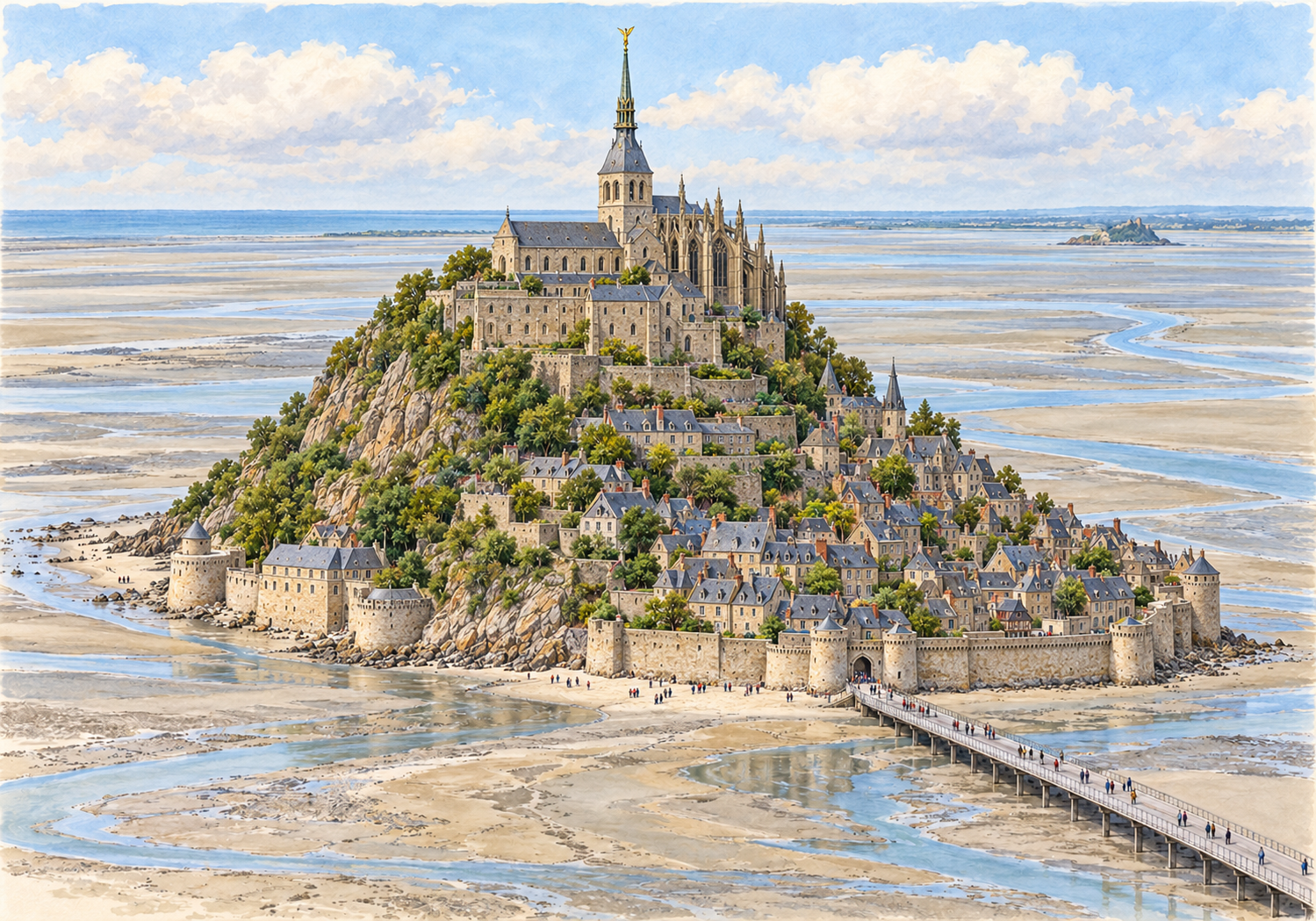
The village climbs the rock below the abbey. This view includes the modern spire and pedestrian bridge.
Present-day view
Enter this sceneEnter the abbey, village and the lives within.
Explore the mount, its rooms and the work of daily life.
The village climbs the rock below the abbey. This view includes the modern spire and pedestrian bridge.
Present-day view
Enter this sceneExplore the illustrated rooms above the village. This cutaway is an interpretation, not a measured architectural plan.
Interpretive reconstruction
The abbey church combines Romanesque and later Gothic construction. This interior brings their contrasting forms into view.
The Merveille is a three-level Gothic complex. Explore the stacked rooms in this interpretive section.
Monastic meals were taken in silence while a reader read aloud. This scene interprets that shared routine.
The cutaway reveals rooms above a bakery and workshop. This is an imagined working day, not a record of particular residents.
Approach the guarded entrance in this reconstructed scene. Its design illustrates defensive gates; it is not an exact portrait of the Porte du Roy.
The Merveille is a three-level Gothic complex. Explore the stacked rooms in this interpretive section.
Interpretive reconstruction
The cloister links spaces for monastic life. Its covered galleries also served prayer and meditation.
Monastic meals were taken in silence while a reader read aloud. This scene interprets that shared routine.
The room beneath the cloister is associated with manuscript work and study. In this reconstruction, desks fill the vaulted hall.
The guest hall lies beneath the refectory. This reconstructed scene explores hospitality through shared tables and conversation.
The cellar stored provisions. Barrels, baskets and jars make that purpose visible in this reconstruction.
The almonry occupies the lower level beneath the guest hall. Food and assistance are the focus of this reconstruction.
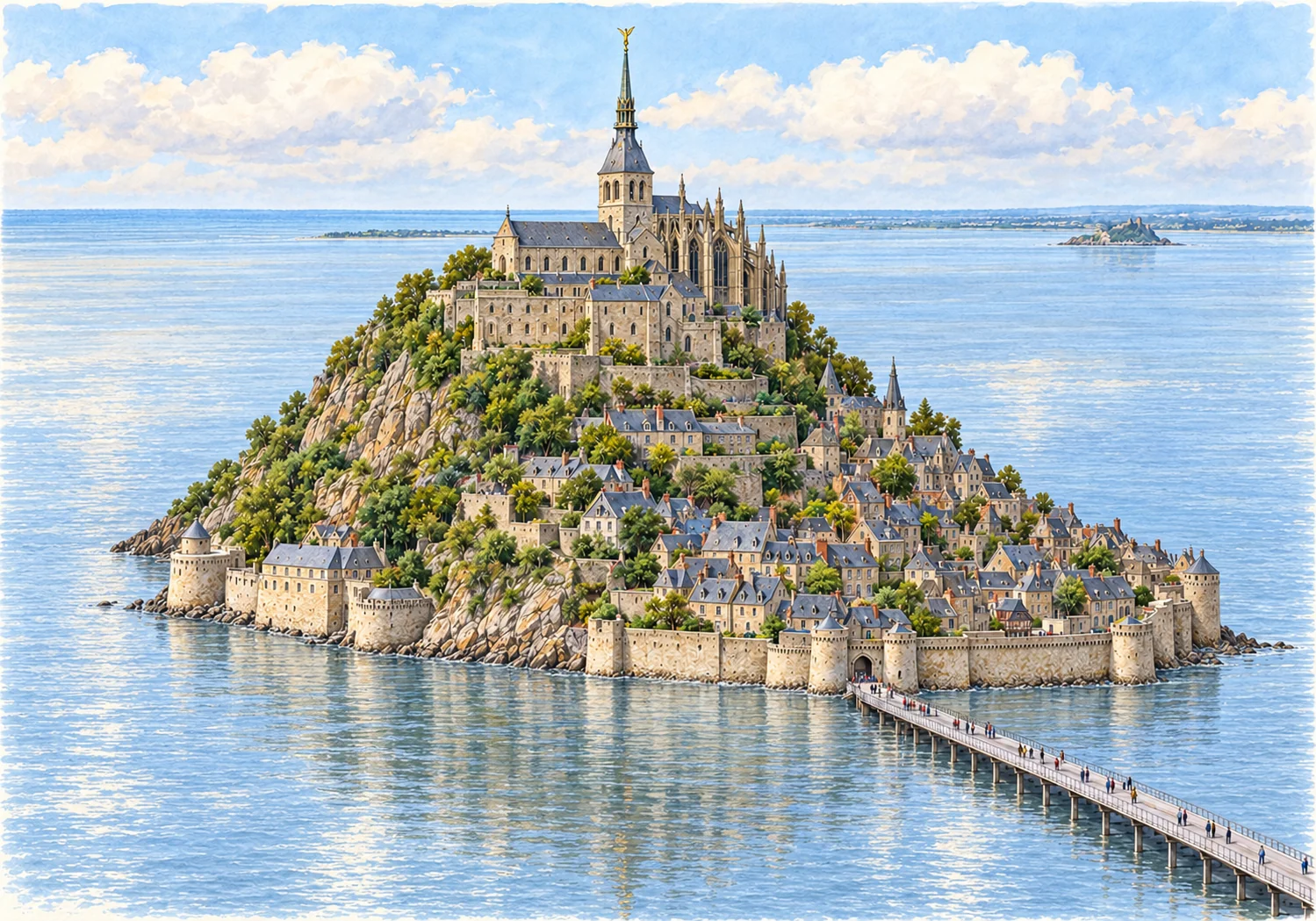
During strong tides, water surrounds the rock. Compare this illustration with the low-tide view.
Present-day view
Enter this sceneApproach the guarded entrance in this reconstructed scene. Its design illustrates defensive gates; it is not an exact portrait of the Porte du Roy.
Interpretive reconstruction
Enter this sceneThe heavy doors close the stone archway. Compare them with the open passage.
Interpretive reconstruction
Enter this sceneThe open doors reveal the way beyond the walls. Look at the hinges, timber and surrounding stonework.
Interpretive reconstruction
Enter this sceneFollow the illustrated wall above the shore. Roofs, towers and narrow paths gather around the steep rock.
Present-day view
Enter this sceneThe abbey church combines Romanesque and later Gothic construction. This interior brings their contrasting forms into view.
Interpretive reconstruction
Enter this sceneThe cloister links spaces for monastic life. Its covered galleries also served prayer and meditation.
Interpretive reconstruction
Enter this sceneThe open shutters frame a view beyond the gallery. This interpretive detail explores light and shelter.
Interpretive reconstruction
Enter this sceneWooden shutters cover the opening. Compare the illustrated states without assuming an exact historical shutter design.
Interpretive reconstruction
Enter this sceneThe room beneath the cloister is associated with manuscript work and study. In this reconstruction, desks fill the vaulted hall.
Interpretive reconstruction
Look closely at the illustrated book-making materials. The arrangement shows the work of preparing and studying pages.
The monk concentrates on a page. Books and tools make this reconstructed moment of study visible.
Look closely at the illustrated book-making materials. The arrangement shows the work of preparing and studying pages.
Interpretive reconstruction
Enter this sceneThe monk concentrates on a page. Books and tools make this reconstructed moment of study visible.
Interpretive reconstruction
Enter this sceneFollow the illustrated stone supports into the rock. This section explains a structural idea, not a measured load diagram.
Interpretive reconstruction
Enter this sceneThis Romanesque crypt supports part of the church above. Its broad barrel vault is the focus of the illustration.
Interpretive reconstruction
Enter this sceneThe preserved wheel was installed in 1818, during the prison period. It lifted provisions. This scene belongs to that later period.
Later mechanism · 1818
The illustrated rope winds around the drum as the axle turns. Its lifting route is schematic, not an engineering drawing.
The illustrated rope winds around the drum as the axle turns. Its lifting route is schematic, not an engineering drawing.
Later mechanism · 1818
Enter this sceneThe guest hall lies beneath the refectory. This reconstructed scene explores hospitality through shared tables and conversation.
Interpretive reconstruction
The steward checks the illustrated supplies. This character represents the work behind a welcoming hall.
The steward checks the illustrated supplies. This character represents the work behind a welcoming hall.
Interpretive reconstruction
Enter this sceneThe almonry occupies the lower level beneath the guest hall. Food and assistance are the focus of this reconstruction.
Interpretive reconstruction
Enter this sceneTravelers gather over food in this scene. Their clothes, utensils and meal are interpretive details.
Interpretive reconstruction
Enter this sceneThe cellar stored provisions. Barrels, baskets and jars make that purpose visible in this reconstruction.
Interpretive reconstruction
Enter this sceneThe donkey carries baskets along the illustrated village path. Compare the loaded and unloaded states.
Interpretive reconstruction
Enter this sceneThe same illustrated task has reached its next stage. Look for the change in the donkey’s baskets.
Interpretive reconstruction
Enter this sceneThe cutaway reveals rooms above a bakery and workshop. This is an imagined working day, not a record of particular residents.
Interpretive reconstruction
Enter this sceneTools and unfinished stone surround the workers. The illustration explores the care involved in repairing masonry.
Interpretive reconstruction
Enter this sceneLook at the mason’s hands, tools and workpiece. This reconstructed character gives the building work a human scale.
Interpretive reconstruction
Enter this sceneMove between the illustrated spaces and their activities. The section gathers different moments into one composition.
Interpretive reconstruction
Enter this sceneA pot warms over the fire while other cooks prepare ingredients. These furnishings and routines are an interpretation of monastic life.
Interpretive reconstruction
The cook works close to the fire. Look at the spoon, hanging pot and ingredients in this reconstructed scene.
Look closely at the pictured meal and its utensils. It illustrates possible staples, not a documented menu for a particular day.
The cook works close to the fire. Look at the spoon, hanging pot and ingredients in this reconstructed scene.
Interpretive reconstruction
Enter this sceneLook closely at the pictured meal and its utensils. It illustrates possible staples, not a documented menu for a particular day.
Interpretive reconstruction
Enter this sceneMonastic meals were taken in silence while a reader read aloud. This scene interprets that shared routine.
Interpretive reconstruction
Enter this sceneThe illustration arranges beds and small belongings in a shared sleeping space. Its furnishings are a reconstruction.
Interpretive reconstruction
Enter this sceneCloth needs work as well as buildings. Look at the washing and mending tasks in this interpretive scene.
Interpretive reconstruction
Enter this scenePeople settle together in an illustrated village home. The small details invite a slower look.
Interpretive reconstruction
Enter this sceneWarm light fills the church as the illustrated community gathers. This reconstructed moment closes the guided journey.
Interpretive reconstruction
Enter this scene