
Palace of Versailles
The Palace of Versailles, near Paris, was the home of the kings and queens of France. Open the palace, then walk from room to room to see how the royal family and their court lived around 1785.
Enter this sceneFollow a day with the king, from his morning to the royal dinner.
The Palace of Versailles, near Paris, was the home of the kings and queens of France. Open the palace, then walk from room to room to see how the royal family and their court lived around 1785.
The Palace of Versailles, near Paris, was the home of the kings and queens of France. Open the palace, then walk from room to room to see how the royal family and their court lived around 1785.
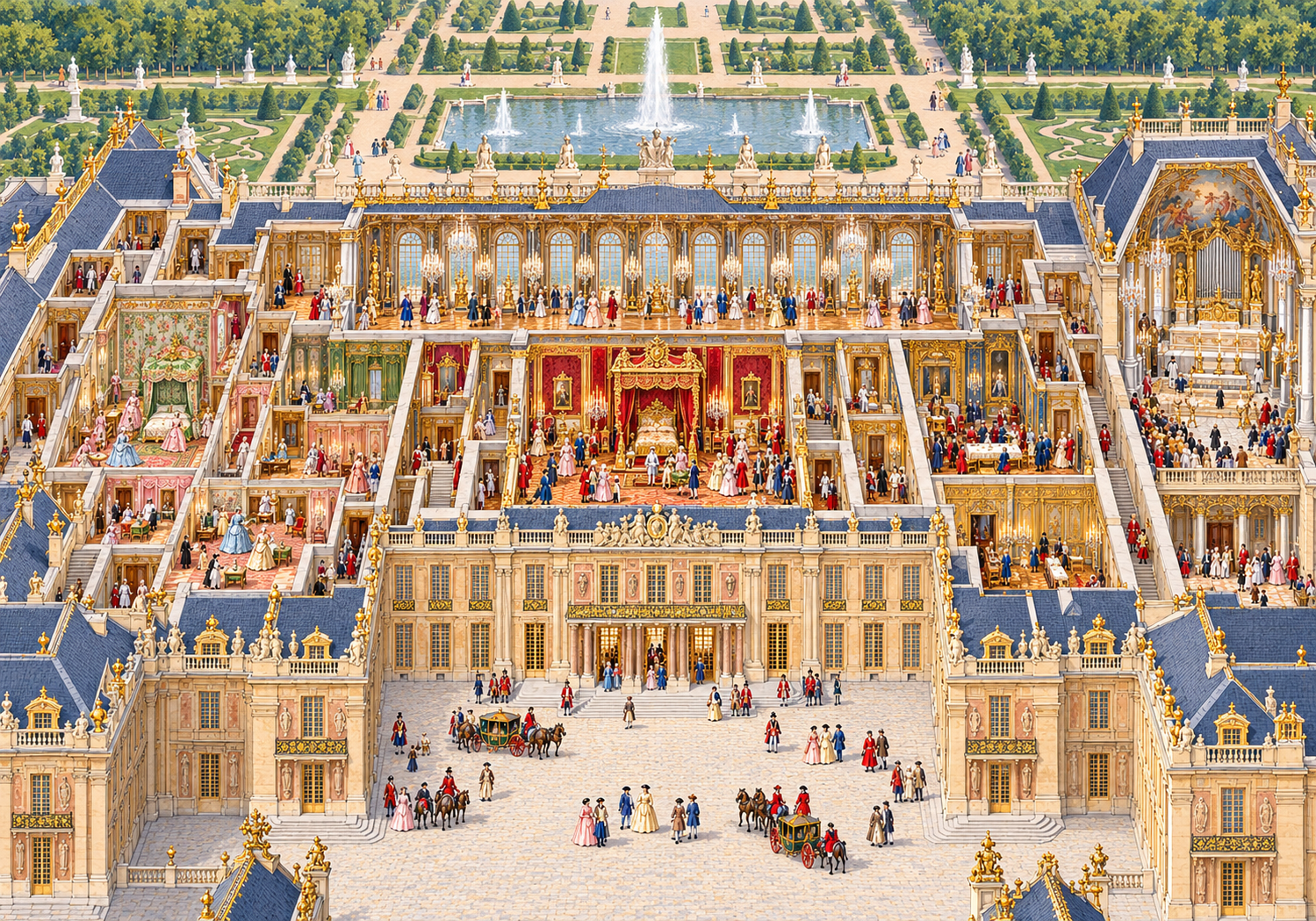
Enter this sceneThis picture opens the palace like a doll's house. Start the visit to follow a day with King Louis XVI, room by room, from his morning ceremony to the royal dinner, or tap any door to walk straight in.
The Hall of Mirrors is a long, bright gallery. Tall windows line one side, and mirrors on the other side reflect the light.
The hall is 73 meters (240 feet) long and has 357 mirrors.
The King's Bedchamber is in the very middle of the palace. Every morning, courtiers came to watch the king get up and dress.
King Louis XIV, known as the Sun King, made this his bedroom in 1701.
In the Council Room, the king met his ministers to talk about the country and make important decisions.
The ministers gave their advice, but the king had the final word.
The King's State Apartments are a row of grand rooms, each one named after a god or planet from old stories.
Several evenings a week, the king opened these rooms for music, card games, dancing and snacks.
The Royal Chapel is where the royal family went to church. It has two levels, one above the other.
The king went to the chapel every day, and the whole court followed him.
The Queen's Bedchamber is where the queen slept and met visitors in the morning. Its walls are covered with flowered silk.
Marie-Antoinette was the last queen to live in this room.
Behind the grand rooms, hundreds of people worked every day: cooks, servants, washers, craftspeople and musicians.
In 1682, King Louis XIV moved his whole court to Versailles, and it became the center of power in France.
Behind the palace are huge gardens with paths, statues and fountains, laid out in neat shapes and straight lines.
The fountains could not all run at once. Fountain keepers turned them on just before the king walked past.
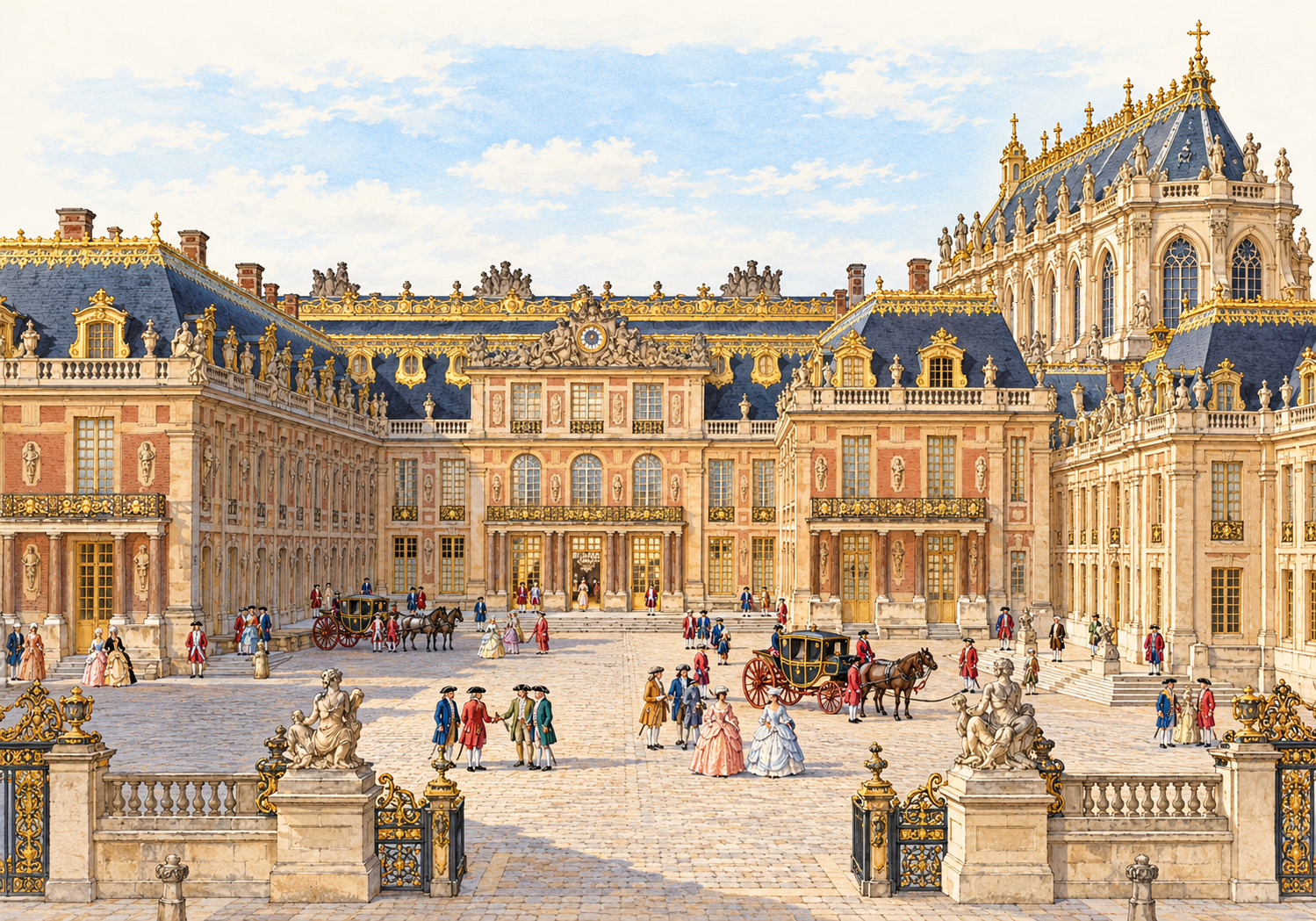
Carriages drove through the golden gates and across the courtyards to bring visitors right up to the palace doors.
The small courtyard in the middle is called the Marble Courtyard because it is paved with black and white marble.
The day begins here. Every morning, courtiers crowded into the King's Bedchamber to watch the king get up and dress, in a ceremony called the lever.
The king's bed stands in an alcove behind a golden railing, under a canopy of red and gold fabric.
Every morning, a ceremony called the lever (le-VAY) took place as the king got up and dressed.
Above the bed, a white sculpture shows France as a woman watching over the king while he sleeps.
It was carved by the sculptor Nicolas Coustou.
The golden railing kept the crowd away from the bed. Only the most important people could go past it.
There was a bedtime ceremony every evening too, called the coucher (koo-SHAY).
The windows look out over the Marble Courtyard, at the front and center of the palace.
The room faces east, toward the rising sun.
An usher stood at the door holding a staff. He decided who was allowed to come into the room.
At Versailles, people gently scratched on a door instead of knocking, as a rule of good manners.
Courtiers waited for a long time for the chance to stand close to the king during the ceremonies.
Handing the king his shirt in the morning was a great honor, given to the most important person in the room.
The doorway beside the usher leads to the Council Room, where the king met his ministers.
Louis XVI used this room for ceremonies, but he slept in a smaller, warmer bedroom nearby.
Then it was time to work. In the Council Room, the king sat with his ministers to talk about France and decide what to do.
King Louis XVI sits at the head of the table. He listened to his ministers before making a decision.
Louis XVI loved geography and helped plan a voyage of exploration around the world in 1785.
A minister is a person who helps the king run one part of the country, such as money, the army or the navy.
Each minister brought papers and reports to explain problems to the king.
The ministers sat around a big table covered with a long cloth, with the king at its head.
What was said in the king's councils was kept secret.
Letters, reports and books lie on the table. Everything was written by hand with a quill pen and ink.
Messengers on horseback carried letters between Versailles and the rest of France.
The armchairs are made of carved wood covered with gold, with seats of blue and gold silk.
Gilding means covering wood with a very thin layer of real gold, called gold leaf.
A door from the Council Room leads straight into the King's Bedchamber next door.
The king could go from his bedroom to his council in just a few steps.
Another door opens onto the Hall of Mirrors, so the king could walk straight out into the long gallery.
The Council Room is also called the Cabinet, an old word for a small private room.
King Louis XVI sits at the head of the table. He listened to his ministers before making a decision. Louis XVI loved geography and helped plan a voyage of exploration around the world in 1785.
Enter this sceneThe king kept his papers in a roll-top desk. Its curved lid slides down to hide and lock away the papers. A desk with a curved sliding lid like this one is called a cylinder desk.
Enter this sceneAfter getting dressed, the king walked to the Royal Chapel for the daily service, sitting in the upper gallery with his family.
The great organ stands above the altar. Air blown through its metal pipes makes music that fills the whole chapel.
The famous composer François Couperin was one of the king's organists.
The altar is the gilded table at the front of the chapel, where priests led the service every day.
The chapel is dedicated to Saint Louis, a king of France who lived about 800 years ago.
The ceiling paintings show scenes from the Bible, painted so that the roof seems to open onto the sky.
The chapel was finished in 1710. It was the last building King Louis XIV added to the palace.
The chapel has two levels. The king and his family sat upstairs, and most other people stayed on the floor below.
Louis XVI and Marie-Antoinette were married in this chapel in 1770. He was 15 and she was 14.
The floor is made of colored marble, cut and fitted together in patterns of circles and squares.
Marble is a hard stone that can be polished until it shines like glass.
On the upper level, doors lead from the chapel straight into the king's grand rooms.
The Hercules Salon, one of the largest rooms in the palace, sits between the chapel and the State Apartments.
The great organ stands above the altar. Air blown through its metal pipes makes music that fills the whole chapel. The famous composer François Couperin was one of the king's organists.
Enter this sceneCourt musicians played at church services, meals, dances and concerts. This one is playing the violin. The king had his own musicians, and music was heard in the palace almost every day.
Enter this sceneIn the afternoon, courtiers filled the Hall of Mirrors, hoping to see the king pass by. Look closer at its mirrors, windows and ceiling.
Each arch on this wall is filled with mirrors. They reflect the windows across the hall, so the room looks twice as bright.
There are 357 mirrors. At the time, large mirrors were very rare and cost a fortune.
Seventeen tall windows look out over the gardens. Sunlight pours in through them and bounces off the mirrors.
Each window faces a matching arch of mirrors on the other side of the hall.
The curved ceiling is covered with paintings by the artist Charles Le Brun. They tell the story of King Louis XIV's reign.
The hall was built between 1678 and 1684 to show visitors how rich and powerful France was.
Gilded candle stands, called torchères, held candles to light up the hall when the sun went down.
On nights of great celebrations, thousands of candles were lit, and the mirrors made the whole hall sparkle.
Courtiers were nobles who lived at the palace. They walked here in their finest clothes, hoping to see the king pass by.
Every day the king crossed this hall on his way to the chapel, and the courtiers lined up to watch.
The floor is made of oak boards fitted together in a pattern of squares, set at an angle like diamonds.
This floor pattern was used so much in the palace that it is still called Versailles parquet today.
At the far end of the hall, a grand room called the War Salon leads into the King's State Apartments.
At the other end of the hall, the Peace Salon leads to the queen's rooms.
A door in the long wall of the hall opens into the king's own rooms, starting with the Council Room.
In 1919, long after the kings, world leaders signed a famous peace treaty in this hall.
Gilded candle stands, called torchères, held candles to light up the hall when the sun went down. On nights of great celebrations, thousands of candles were lit, and the mirrors made the whole hall sparkle.
Enter this sceneSeveral evenings a week, the king opened his State Apartments for music, card games and dancing. This is the Apollo Salon, where his throne stood.
In the Apollo Salon, the king's throne stood on a raised platform under a canopy. Here he welcomed important visitors.
King Louis XIV's first throne was made of solid silver and was taller than a grown-up.
The ceiling shows Apollo, the sun god of old Greek stories, riding his chariot across the sky.
King Louis XIV was called the Sun King, so the sun god Apollo was his favorite symbol.
A chandelier is a hanging light with many candles. Its glass drops catch the candlelight and scatter it around the room.
Before electric lights, every room in the palace was lit by candles, lamps and fireplaces.
A tapestry is a picture woven from colored threads. Big tapestries decorated the walls and helped keep rooms warmer.
Many tapestries for the king were woven at the royal Gobelins workshop in Paris.
Courtiers followed strict rules about how to stand, bow and walk in front of the king and queen.
These rules of polite behavior were called etiquette, a French word we still use today.
The open doors lead along the row of grand rooms, one after another, all the way to the Hall of Mirrors.
A straight line of doors that lets you see through many rooms at once is called an enfilade.
In the evening, the queen's rooms came to life. Look closer at Marie-Antoinette's bed, the silk walls and the little stools, and find the hidden door.
The queen's bed stands behind a golden railing. Its canopy is topped with fluffy white feathers.
Nineteen royal children were born in this room.
The golden railing separates the bed from the rest of the room. Only certain people could step past it.
Every morning, the queen received visitors in this room as part of daily life at court.
The walls are covered with silk decorated with flowers, ribbons and feathers, matching the bed and chairs.
The fabrics were changed with the seasons, with lighter silks in summer and warmer ones in winter.
The little padded stools are called tabourets. Most ladies had to stand when they were with the queen.
Only duchesses and a few other high-ranking ladies were allowed to sit on a stool near the queen.
A marble fireplace warmed the room. In winter, fires burned in fireplaces all over the palace.
Big palaces like Versailles were very hard to keep warm, so people wore many layers of clothes.
Marie-Antoinette became queen of France in 1774. She lived at Versailles from 1770, when she married Louis XVI.
She was born in Austria and came to France when she was 14 years old.
Next to the bed, part of the flowered wall is really a door. When it is closed, it is very hard to spot.
Hidden doors let the queen move between her rooms without crossing the crowded public rooms.
From the queen's rooms, a grand room called the Peace Salon leads into the Hall of Mirrors.
A small door hidden in the wall next to the bed led to the queen's private rooms.
Marie-Antoinette became queen of France in 1774. She lived at Versailles from 1770, when she married Louis XVI. She was born in Austria and came to France when she was 14 years old.
Enter this sceneThe day ends with the royal dinner, eaten in public. Go behind the scenes to follow it from the kitchens to the table, and meet the people who ran the palace.
Dozens of cooks, bakers and helpers worked in the palace kitchens. Meat roasted over big fires, and copper pots hung on the walls.
The kitchens were far from the royal table, so the food often arrived only warm, not hot.
At the Grand Couvert, the king and queen ate their dinner in public, and visitors could come in to watch them eat.
The king and queen sat side by side with their backs to the fireplace, and the queen sat on the king's left.
Storerooms were filled with flour, bread, barrels and baskets, enough food for everyone who lived and worked at the palace.
Hundreds of people who worked for the palace lived in a big building next to it, called the Grand Commun.
Sheets, tablecloths and clothes were kept here on tall shelves, folded neatly and ready to use.
All the royal clothes and sheets were washed, ironed and mended by hand, without any machines.
In her small private rooms, Marie-Antoinette could rest, read and sew, away from the crowds of the court.
These rooms were tucked behind the grand rooms and reached by little doors and corridors.
Louis XVI's library was full of books about geography, history and science. He liked to read and study maps.
The king was also good with his hands, and making locks was one of his hobbies.
In the evening, servants drew the curtains, lit the candles and got the rooms ready for the night.
Many servants slept in small rooms nearby, so they could come quickly when they were called.
Gilders covered carved wood with thin sheets of real gold, called gold leaf, to make frames and furniture shine.
Gold leaf is so thin that it floats in the air and is picked up with a soft, wide brush.
The palace household was everyone who served the royal family, from cooks and maids to guards and coachmen.
Each job had its own name and rules, and many families served the palace for generations.
Dozens of cooks, bakers and helpers worked in the palace kitchens. Meat roasted over big fires, and copper pots hung on the walls. The kitchens were far from the royal table, so the food often arrived only warm, not hot.
Enter this sceneThis cook is stirring a soup in a shiny copper pot. Cooks started work long before the royal family woke up. Copper pots heat up quickly and evenly, which is why cooks loved them.
Enter this sceneServants carried the food to the table under silver covers, to keep it warm and clean on the long way. When the king's food passed by, courtiers bowed to it, as a sign of respect for the king.
Enter this sceneAt the Grand Couvert, the king and queen ate their dinner in public, and visitors could come in to watch them eat. The king and queen sat side by side with their backs to the fireplace, and the queen sat on the king's left.
Enter this sceneA royal meal had many dishes: soups, roasts, vegetables, fruit and sweet tarts, served on fine porcelain and silver. Many royal plates were made at the royal porcelain factory of Sèvres, near Paris.
Enter this sceneStorerooms were filled with flour, bread, barrels and baskets, enough food for everyone who lived and worked at the palace. Hundreds of people who worked for the palace lived in a big building next to it, called the Grand Commun.
Enter this sceneThe people who worked at the palace ate simpler meals together at long wooden tables: soup, bread, cheese and stew. Bread was the most important food for most people in France at that time.
Enter this sceneSheets, tablecloths and clothes were kept here on tall shelves, folded neatly and ready to use. All the royal clothes and sheets were washed, ironed and mended by hand, without any machines.
Enter this sceneThese servants are folding and mending linen. Every small tear was sewn up with a needle and thread. Irons were heated on a stove before use, because there was no electricity.
Enter this sceneIn her small private rooms, Marie-Antoinette could rest, read and sew, away from the crowds of the court. These rooms were tucked behind the grand rooms and reached by little doors and corridors.
Enter this sceneIn the evening, the queen and her friends played music and talked. Marie-Antoinette played the harp. She had music lessons as a child in Austria and loved to sing.
Enter this sceneLouis XVI's library was full of books about geography, history and science. He liked to read and study maps. The king was also good with his hands, and making locks was one of his hobbies.
Enter this sceneBehind the grand rooms were smaller, cozier rooms where the king could read, write and talk with a few people. These rooms were warmer and quieter than the huge state rooms.
Enter this sceneGilders covered carved wood with thin sheets of real gold, called gold leaf, to make frames and furniture shine. Gold leaf is so thin that it floats in the air and is picked up with a soft, wide brush.
Enter this sceneA cabinetmaker builds fine furniture. This one is fitting thin pieces of different woods together to make a picture. Making pictures from small pieces of wood is called marquetry.
Enter this sceneThis cutaway shows how a palace room was built: stone walls and wooden floor beams, then paneling, paint and gold. Building and decorating Versailles took many years and thousands of workers.
Enter this sceneThe palace household was everyone who served the royal family, from cooks and maids to guards and coachmen. Each job had its own name and rules, and many families served the palace for generations.
Enter this sceneBehind the palace, straight paths cross gardens, groves and fountains. Follow the central view toward the Grand Canal, or look closer at the people and plants nearby.
Latona stands with her children, Apollo and Diana, above the fountain. Gilded frogs and lizards surround the marble tiers. Thin jets of water curve into the basin.
The Grand Canal stretches through the park. A second arm crosses the long main channel. Its calm water reflects the trees and sky, and small boats carry passengers across the water.
Latona stands with her children, Apollo and Diana, above the fountain. Gilded frogs and lizards surround the marble tiers. Thin jets of water curve into the basin.
The marble group tells the story of Latona, Apollo and Diana.
Water flows from small gilded frogs and lizards around the tiers.
In summer, orange and lemon trees stand outside in wooden boxes. In winter, gardeners move them into the sheltered stone galleries beneath the palace terrace.
Orange and lemon trees grow in wooden containers that gardeners can move.
The trees shelter inside the Orangery galleries during winter.
The Grand Canal stretches through the park. A second arm crosses the long main channel. Its calm water reflects the trees and sky, and small boats carry passengers across the water.
Rowers move the small wooden boats with oars.
The straight channels make a long view through the park.
Gardeners clipped hedges, cared for flowers and watered plants. Their daily work kept the garden patterns clear and the trees healthy.
Gardeners trim the hedge by hand with long shears.
A gardener loosens the soil and tends the flowers.
A watering can carries water to the plants.
In the evening, servants drew the curtains, lit the candles and got the rooms ready for the night. Many servants slept in small rooms nearby, so they could come quickly when they were called.
Enter this sceneCarriages drove through the golden gates and across the courtyards to bring visitors right up to the palace doors. The small courtyard in the middle is called the Marble Courtyard because it is paved with black and white marble.
Enter this scene